Build a Local RAG Using Ollama, PostgreSQL and BladePipe

Retrieval-Augmented Generation (RAG) is becoming increasingly common in enterprise applications. Unlike lightweight Q&A systems designed for personal users, enterprise RAG solutions must be reliable, controllable, scalable, and most importantly—secure.
Many companies are cautious about sending internal data to public cloud-based models or vector databases due to the risk of sensitive information leakage. For industries with strict compliance needs, this is often a dealbreaker.
To address these challenges, BladePipe now supports building local RAG services with Ollama, enabling enterprises to run intelligent RAG services entirely within their own infrastructure. This article walks you through building a fully private, production-ready RAG application—without writing any code.
If you’re okay running your RAG stack on cloud LLMs (like OpenAI) and just want a quick, beginner-friendly setup, you can follow Build A RAG Chatbot with OpenAI - A No-Code Beginner's Guide.
What is an Enterprise-Grade RAG Service?
Enterprise-grade RAG emphasizes end-to-end integration, data control, and tight alignment with business systems. The goal isn’t just smart Q&A. It brings automation and intelligence that genuinely boost business.
Compared to hobby or research-focused RAG setups, enterprise systems have four key traits:
- Fully private stack: All components must run locally or in a private cloud. No data leaves the enterprise boundary.
- Diverse data sources: Beyond plain text files. Databases and more formats are supported.
- Incremental data syncing: Business data updates constantly. RAG indexes must stay in sync automatically.
- Integrated tool calling (MCP-like capabilities): Retrieval and generation are only part of the story. Tools like SQL query, function calls, or workflow execution must be supported.
Introducing BladePipe RagApi
BladePipe’s RagApi encapsulates both vector search and LLM-based Q&A capabilities and supports the MCP protocol. It’s designed to help every one quickly launch their own RAG services.
If you’re building RAG with code-first frameworks, our roundup of the best LangChain alternatives can help you evaluate other orchestration stacks before you commit.
Compared to the traditional way to build RAG services, RagApi's key advantages include:
- Two DataJobs for a RAG service: Import documents + publish API.
- Zero-code deployment: Everything is configurable—no development needed.
- Adjustable parameters: Adjust vector top-K, match threshold, prompt templates, model temperature, etc.
- Multi-model and platform support: Support DashScope (Alibaba Cloud), OpenAI, DeepSeek, and more.
- OpenAI-compatible API: Easily integrate into your existing chat UI or toolchain.
Demo
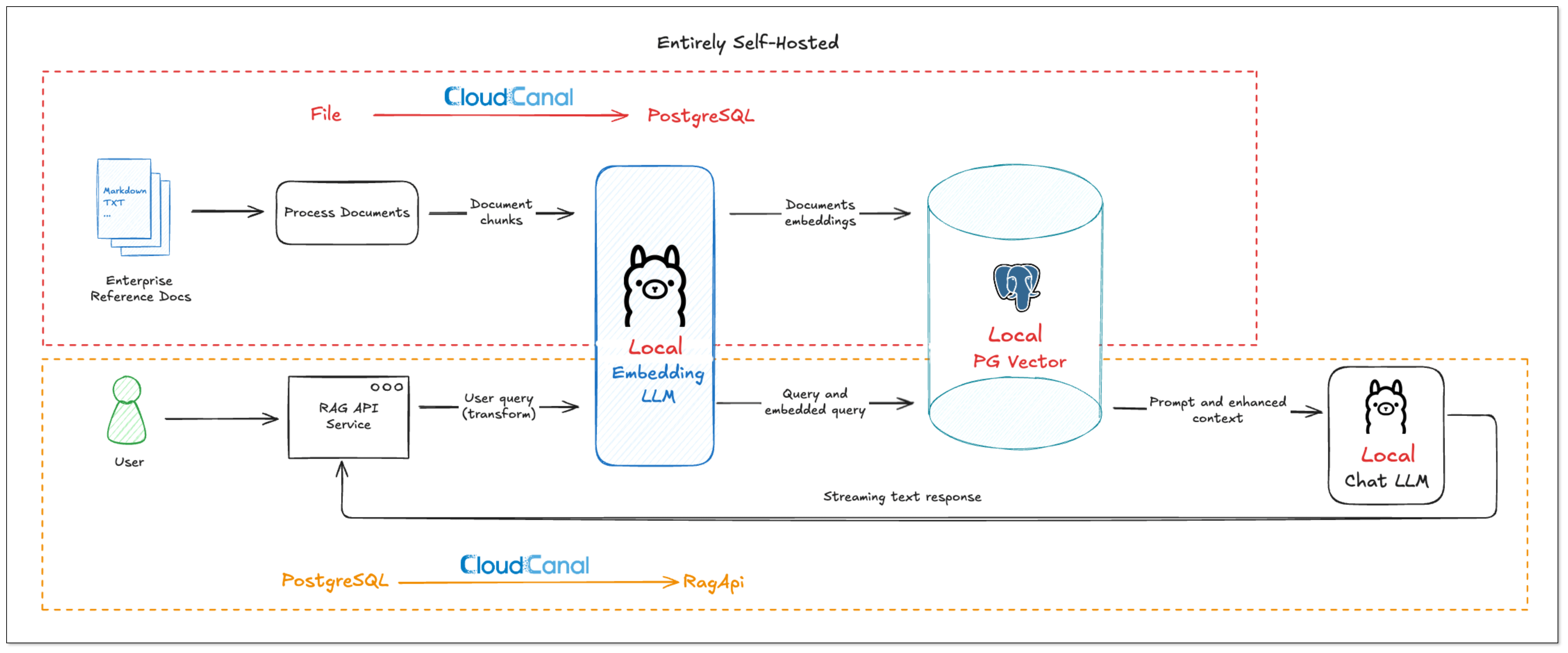
Here’s how to build a fully private, secure RAG service using:
- Ollama for local model reasoning and embedding.
- PostgreSQL for local vector storage.
- BladePipe RagApi for building and managing the RagApi service.
The overall workflow is like:
Preparation
Run Ollama Locally
Ollama allows you to deploy LLMs on your local machine. It will be used for both embedding and reasoning.
- Download Ollama from https://ollama.com/download
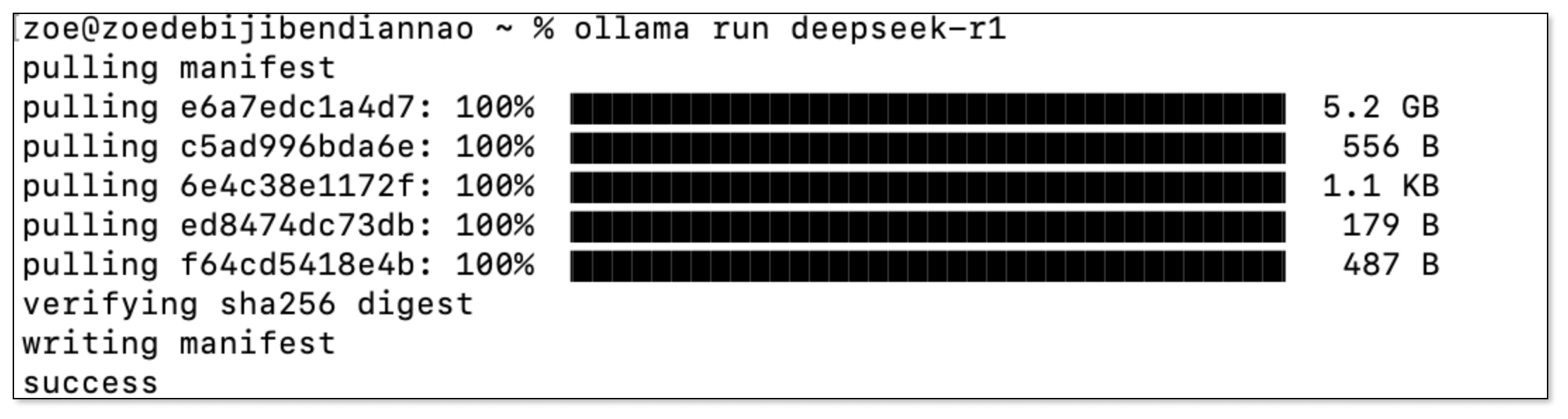
- After installation, run the following command to pull and run a suitable model for embedding and reasoning, such as
deepseek-r1. Note: Large models may require significant hardware resources.
ollama run deepseek-r1
Set Up PGVector
- Install Docker (Skip if already installed): For different operating systems, refer to the following steps for installation:
- MacOS: Refer to the official installation doc: Docker Desktop for Mac.
- CentOS / RHEL: Refer to the script below.
## centos / rhel
sudo yum-config-manager --add-repo https://mirrors.aliyun.com/docker-ce/linux/centos/docker-ce.repo

sudo yum install -y docker-ce-20.10.9-3.* docker-ce-cli-20.10.9-3.*

sudo systemctl start docker

sudo echo '{"exec-opts": ["native.cgroupdriver=systemd"]}' > /etc/docker/daemon.json

sudo systemctl restart docker
- Ubuntu: Refer to the script below.
## ubuntu
curl -fsSL https://mirrors.aliyun.com/docker-ce/linux/ubuntu/gpg | sudo apt-key add -

sudo add-apt-repository "deb [arch=amd64] https://mirrors.aliyun.com/docker-ce/linux/ubuntu $(lsb_release -cs) stable"

sudo apt-get update

sudo apt-get -y install docker-ce=5:20.10.24~3-0~ubuntu-* docker-ce-cli=5:20.10.24~3-0~ubuntu-*

sudo systemctl start docker

sudo echo '{"exec-opts": ["native.cgroupdriver=systemd"]}' > /etc/docker/daemon.json

sudo systemctl restart docker
- Start PostgreSQL + pgvector Container Service: Execute the following command to deploy the PostgreSQL environment in one go:
cat <<'EOF' > init_pgvector.sh
#!/bin/bash

# create docker-compose.yml
cat <<YML > docker-compose.yml
version: "3"
services:
  db:
    container_name: pgvector-db
    hostname: 127.0.0.1
    image: pgvector/pgvector:pg16
    ports:
      - 5432:5432
    restart: always
    environment:
      - POSTGRES_DB=api
      - POSTGRES_USER=root
      - POSTGRES_PASSWORD=123456
YML

# Start container service (run in background)
docker-compose up --build -d

# Wait for container to start, then enter database and enable vector extension
echo "Waiting for container to start..."
sleep 5

docker exec -it pgvector-db psql -U root -d api -c "CREATE EXTENSION IF NOT EXISTS vector;"
EOF

# Grant execution permissions and run the script
chmod +x init_pgvector.sh
./init_pgvector.sh
After execution, local PostgreSQL will automatically enable the pgvector extension, ready to store document embeddings securely on-prem.
Deploy BladePipe (Enterprise)
Follow the installation guide to download BladePipe (Enterprise).
RAG Building
Add DataSources
Log in to BladePipe. Click DataSource > Add DataSource.
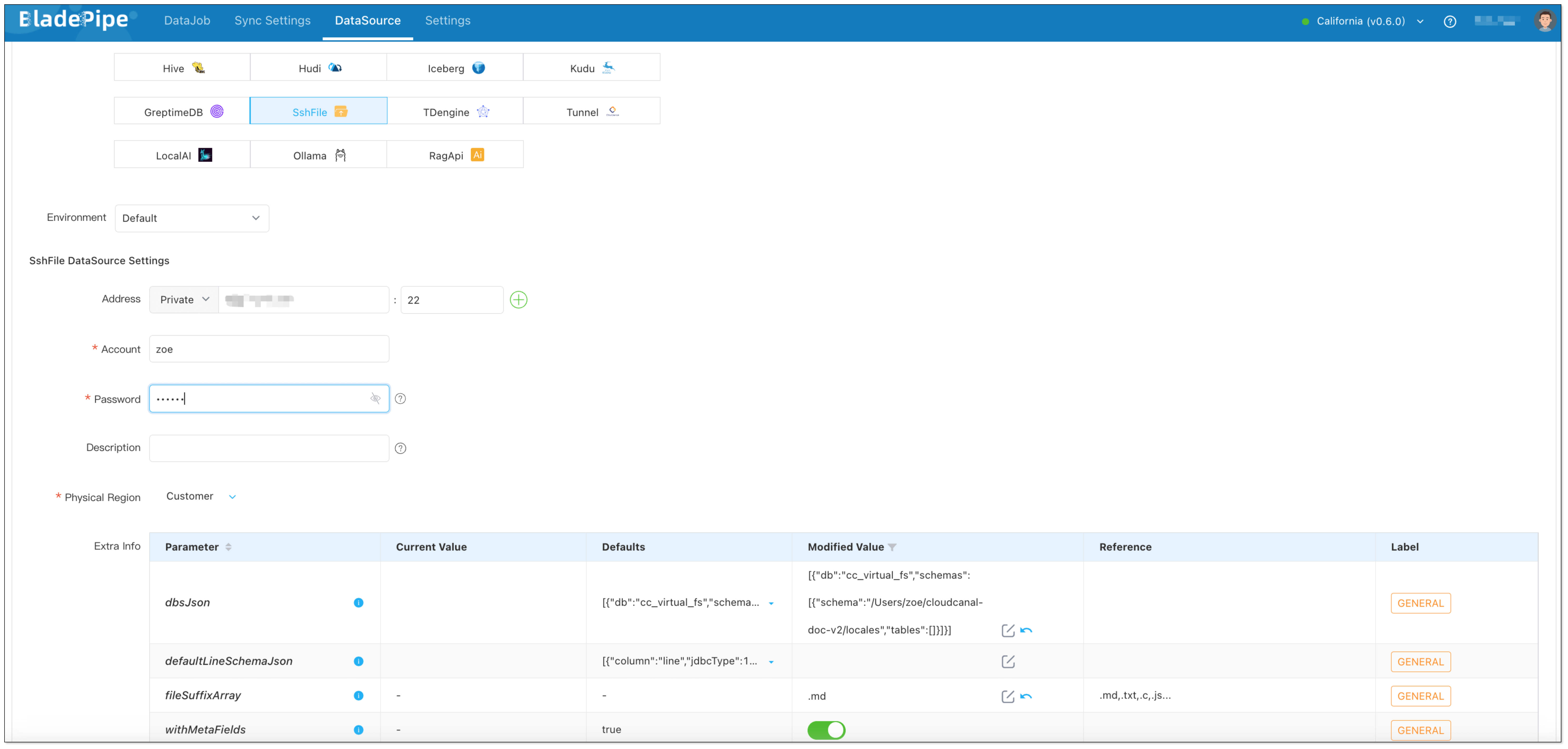
Files(SshFile):
Select Self Maintenance > SshFile. You can set extra parmeters.
- Address: Fill in the machine IP where the files are stored and SSH port (default 22).
- Account & Password: Username and password of the machine.
- Parameter fileSuffixArray: set to
.mdto include markdown files. - Parameter dbsJson: Copy the default value and modify the schema value (the root path where target files are located)
[
  {
    "db":"cc_virtual_fs",
    "schemas":[
      {
        "schema":"/Users/zoe/cloudcanal-doc-v2/locales",
        "tables":[]
      }
    ]
   }
]
Vector Database(PostgreSQL):
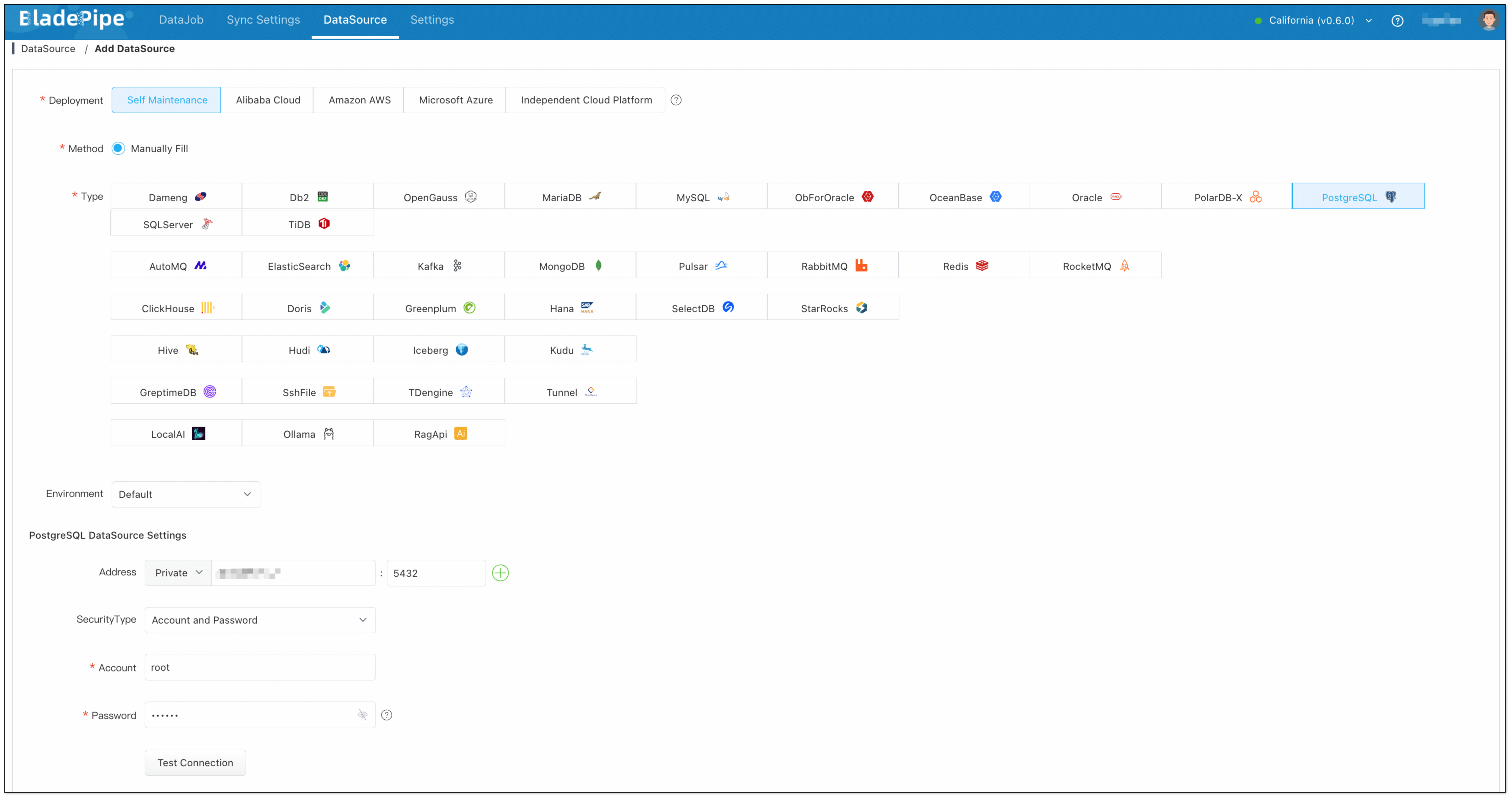
Choose Self Maintenance > PostgreSQL.
Configuration Details:
- Address: localhost:5432
- Account: root
- Password: 123456
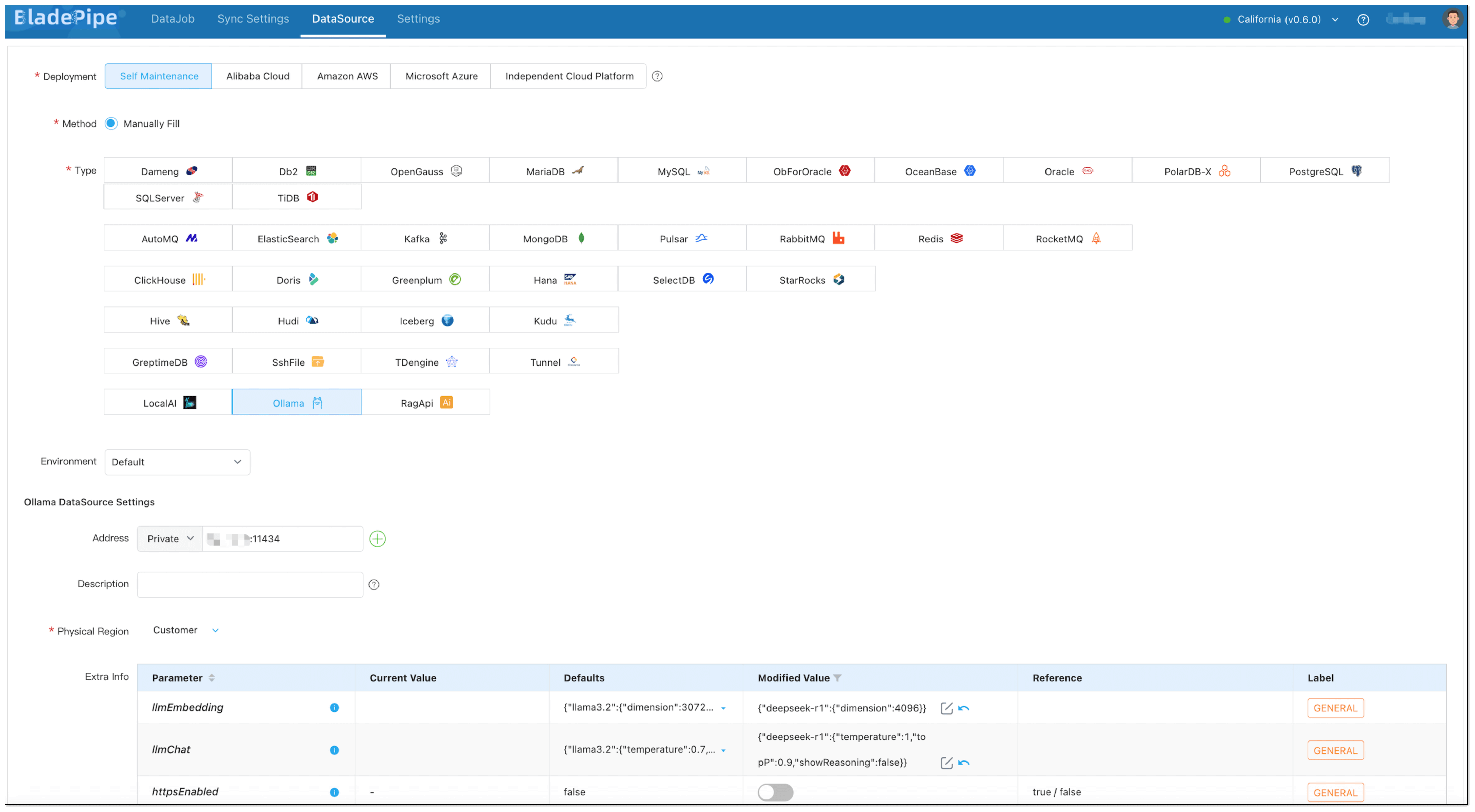
LLM (Ollama):
Choose Self Maintenance > Ollama.
Configuration Details:
- Address: localhost:11434
- Parameter llmEmbedding:
{
  "deepseek-r1": {
    "dimension": 4096
  }
}
- Parameter llmChat:
{
  "deepseek-r1": {
    "temperature": 1,
    "topP": 0.9,
    "showReasoning": false
  }
}
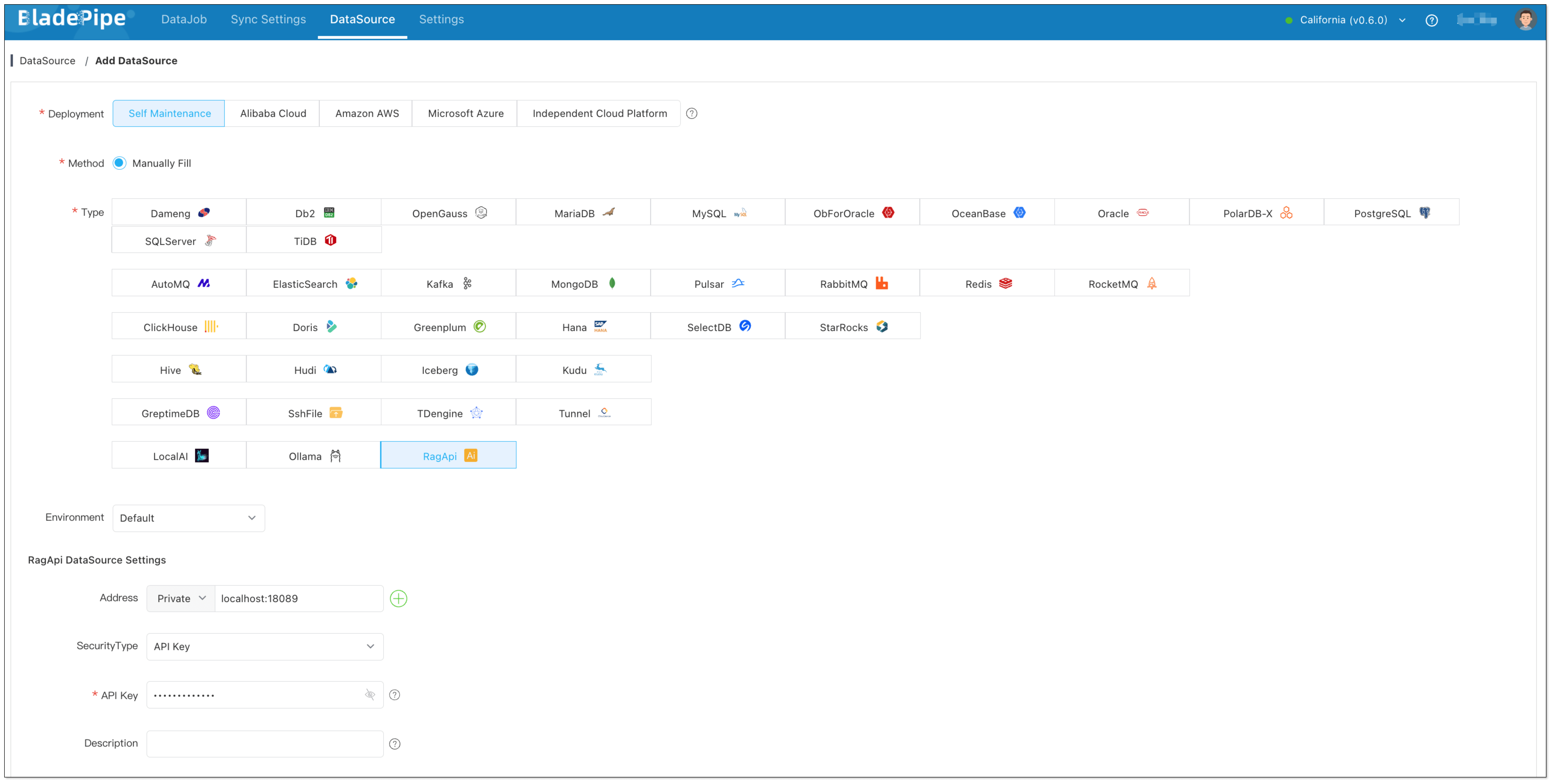
RagApi Service (BladePipe):
Choose Self Maintenance > RagApi.
- Address: Set host to localhost and port to 18089.
- API Key: Customize a string (e.g.
my-bp-rag-key), used for authentication when calling RagApi later.
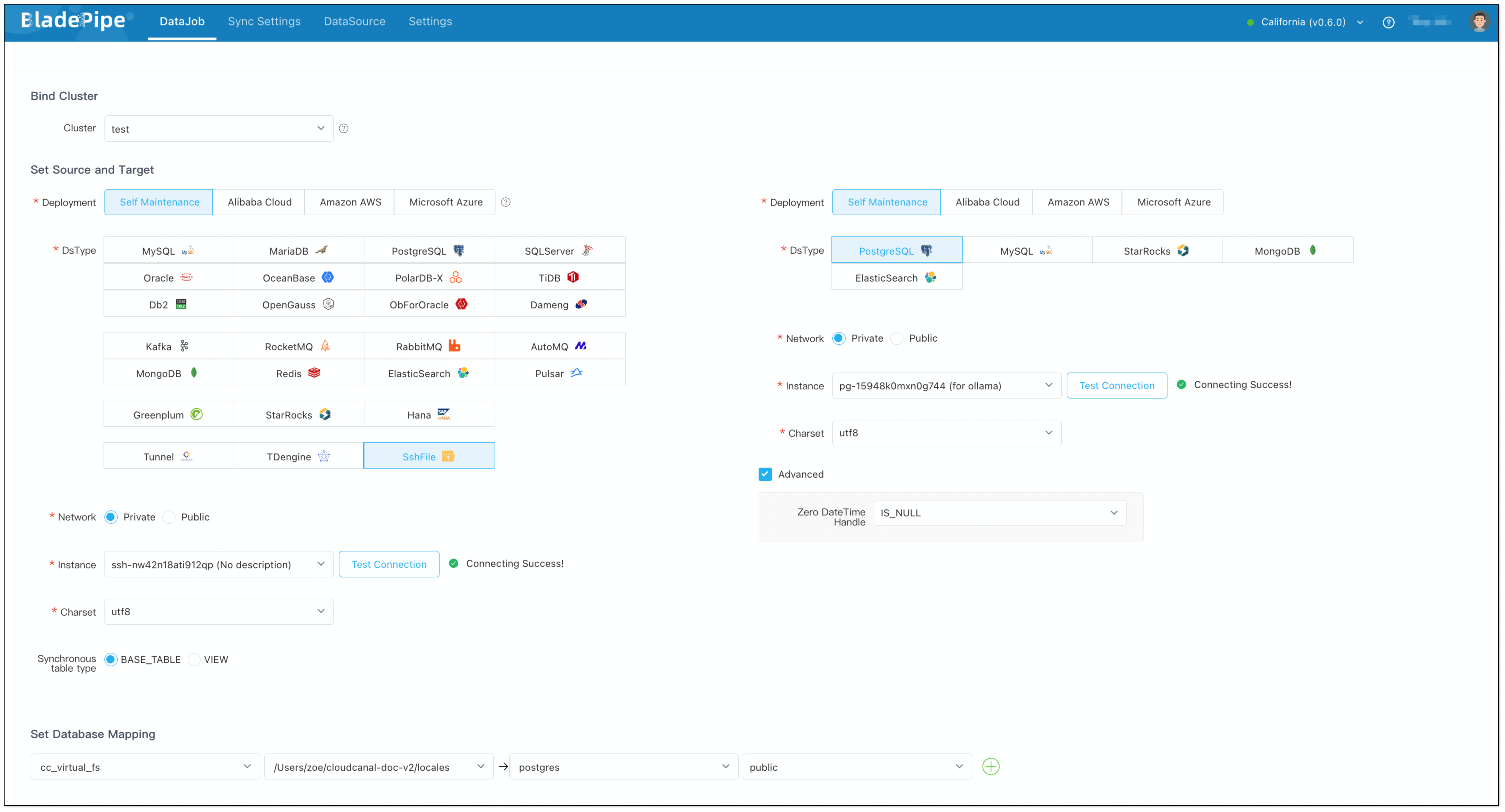
DataJob 1: Vectorize the Docs
- Go to DataJob > Create DataJob.
- Choose source: SshFile, target: PostgreSQL, and test the connection.
- Select Full Data for DataJob Type. Keep the specification as default (2 GB).
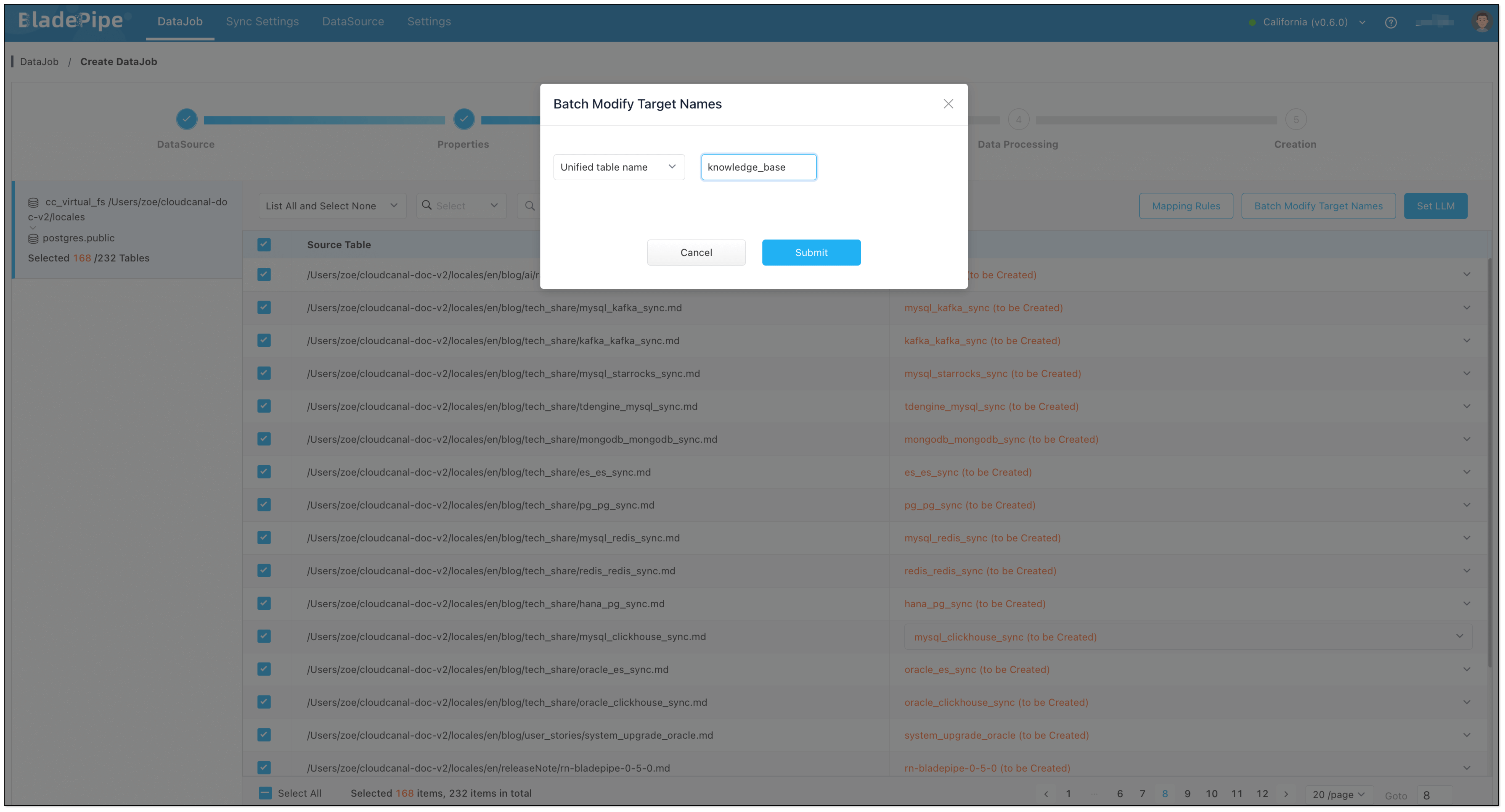
- In Tables page,
- Select the markdown files you want to process.
- Click Batch Modify Target Names > Unified table name, and fill in the table name (e.g.
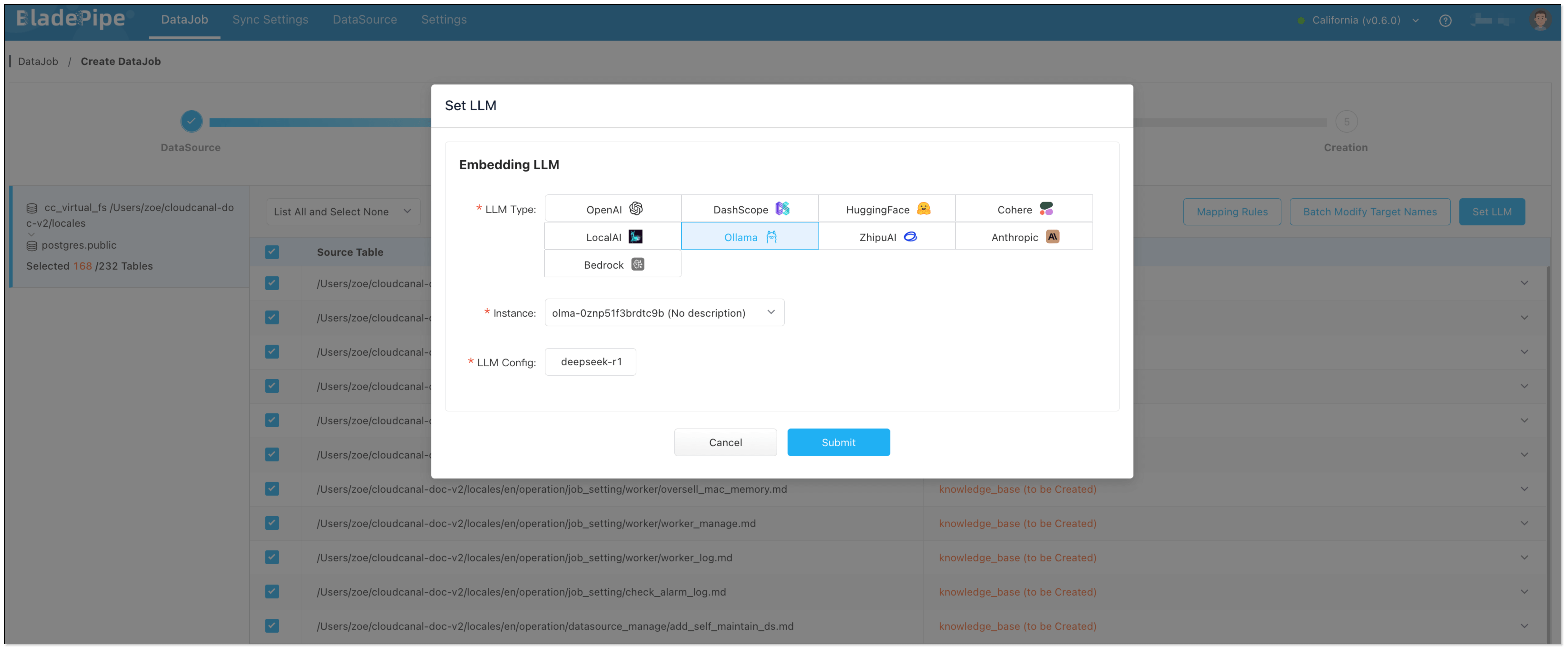
knowledge_base). - Click Set LLM > Ollama, and select the instance and the embedding model.
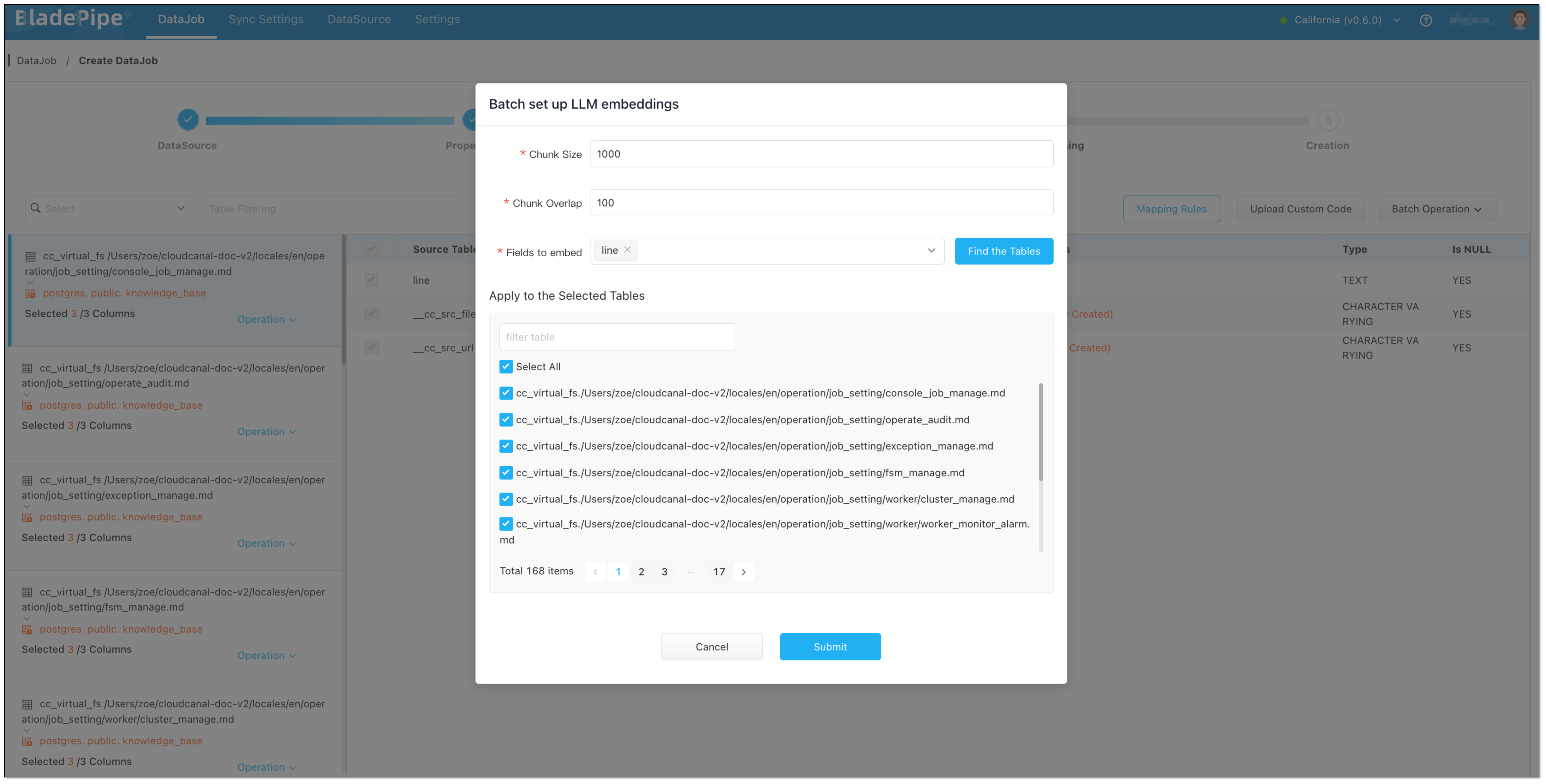
- In Data Processing page, click Batch Operation > LLM embedding. Select the fields for embedding, and check Select All.
- In Creation page, click Create DataJob.

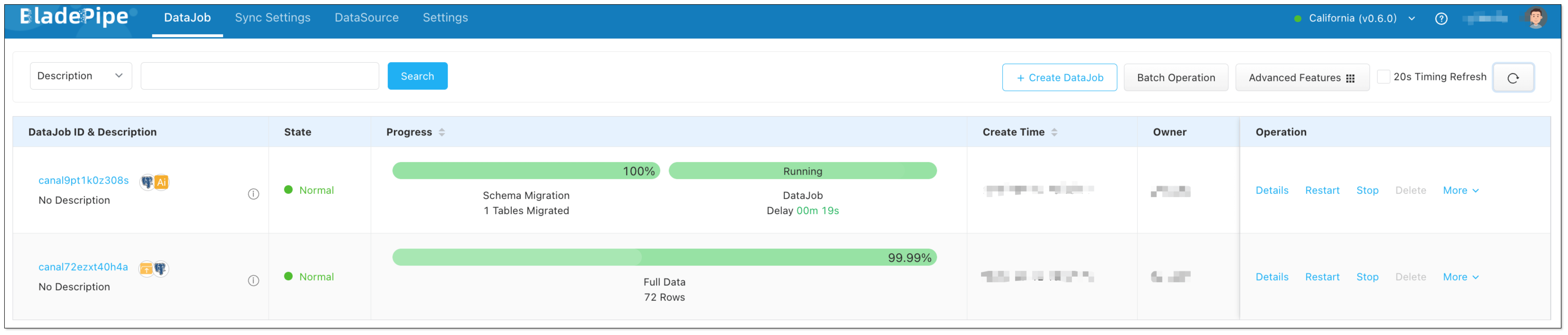
DataJob 2: Build RagApi Service
- Go to DataJob > Create DataJob.
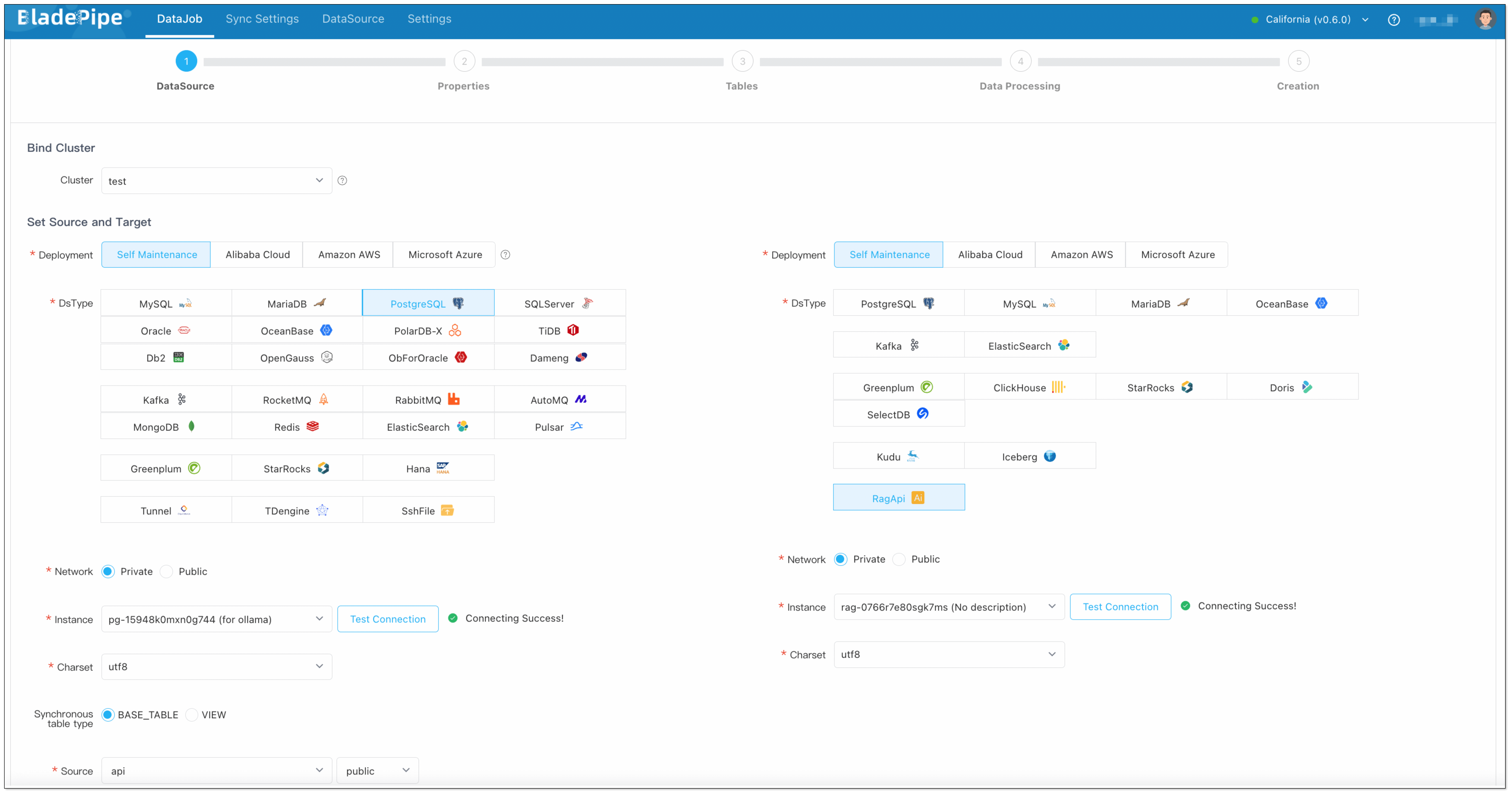
- Choose source: PostgreSQL(with vectors stored), target: RagApi, and test the connection.
- Select Incremental for DataJob Type. Keep the specification as default (2 GB).
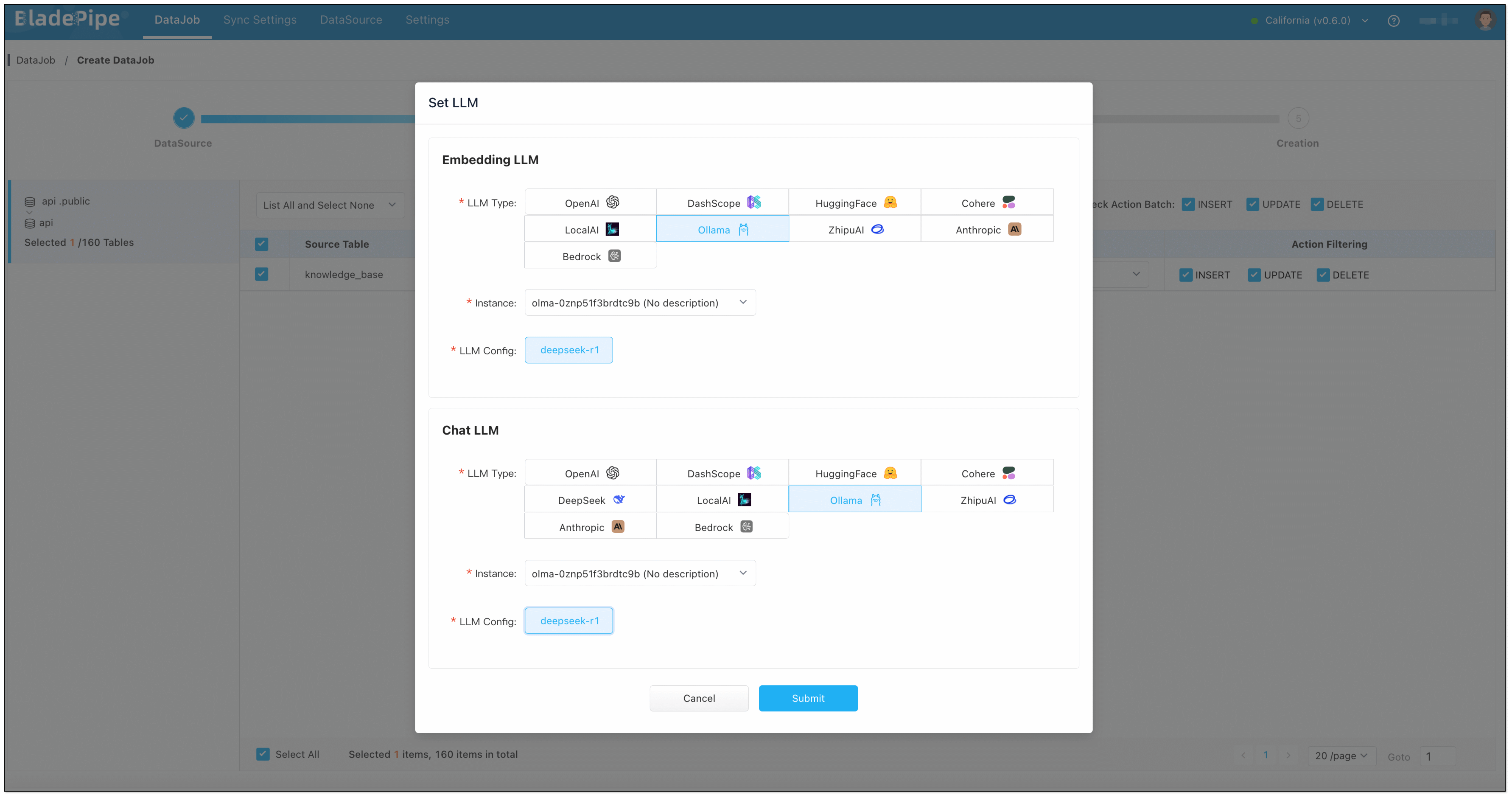
- In Tables page, select the vector table(s). Then, click Set LLM, and choose Ollama as the Embedding LLM and Chat LLM.
- In Creation page, click Create DataJob to finish the setup.
- Perform a simple test using the following command:
curl http://localhost:18089/v1/chat/completions \
  -H "Content-Type: application/json" \
  -H "Authorization: Bearer my-cc-rag-key" \
  -d '{
        "messages": [
          {"role": "system", "content": "You are a helpful assistant."},
          {"role": "user", "content": "Hello!"}
        ],
        "stream": false
      }'
Test
You can test the RagApi with CherryStudio, a visual tool that supports OpenAI-compatible APIs.
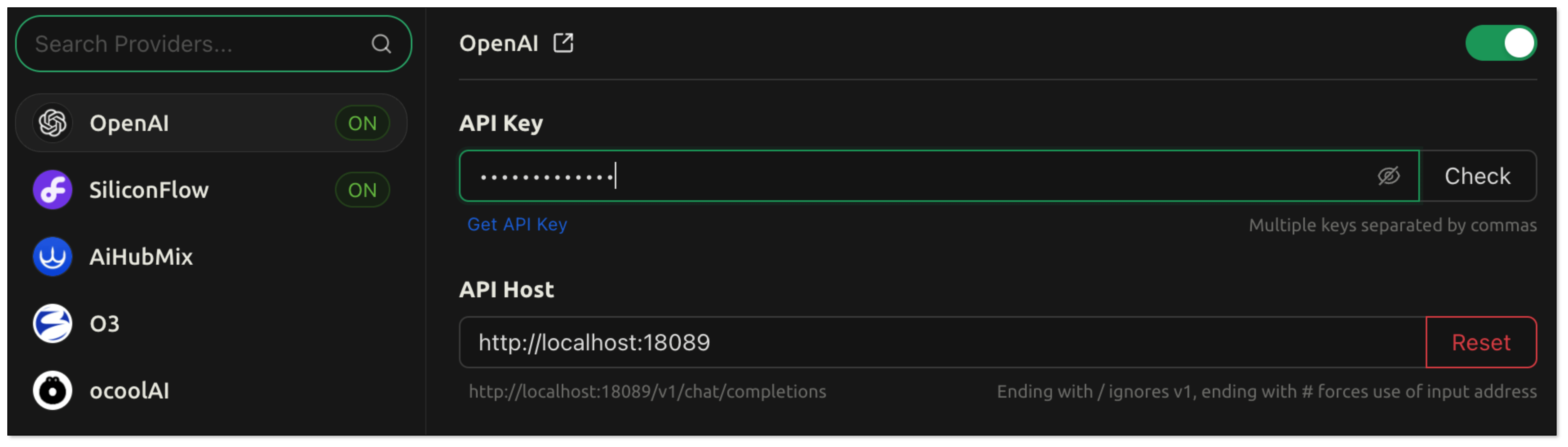
- Open CherryStudio, click the Settings icon in the bottom left corner.
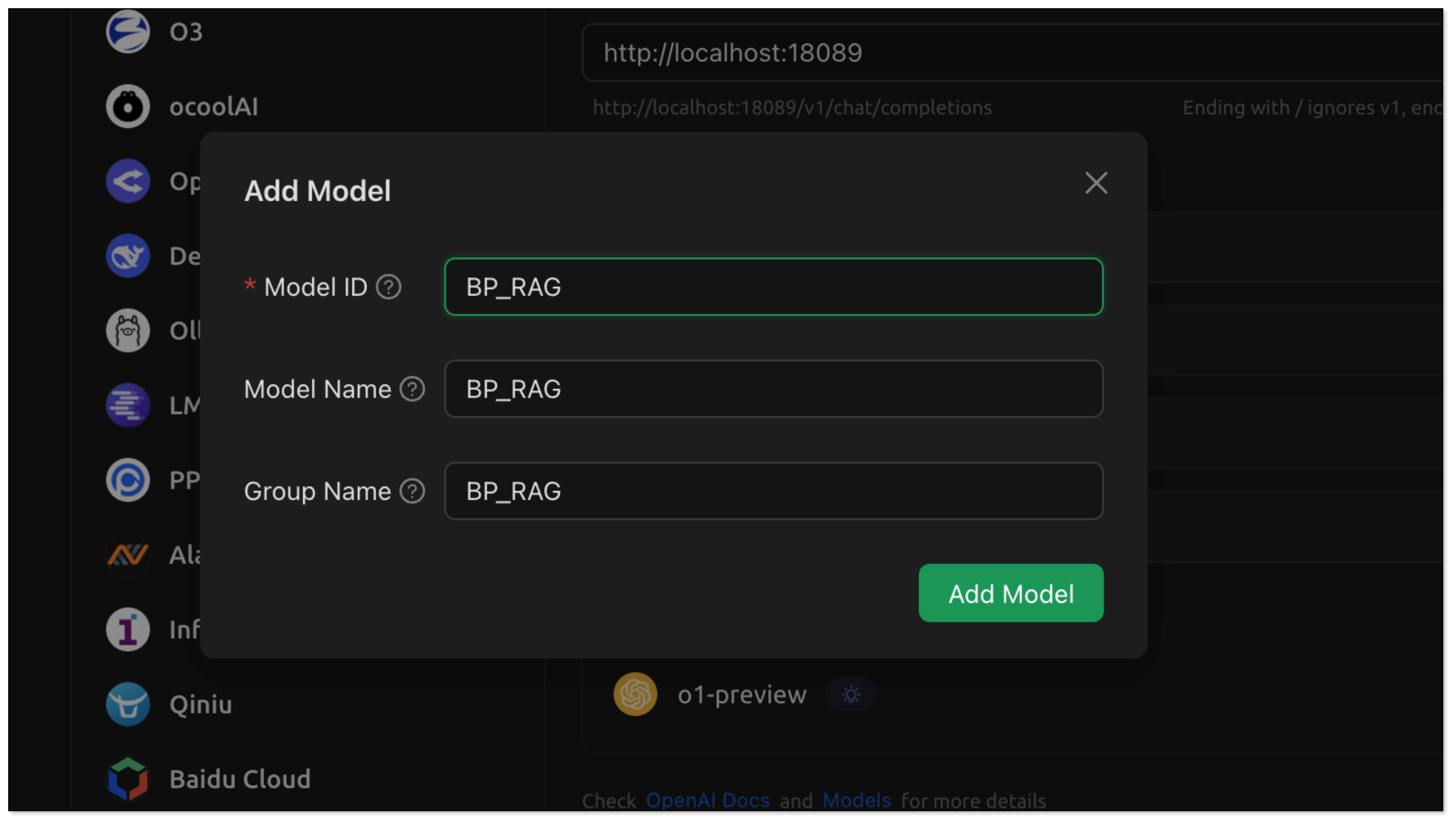
- Under Model Provider, search for OpenAI and configure:
- API Key: your RagApi key configured in BladePipe
- API Host:
http://localhost:18089 - Model ID: BP_RAG
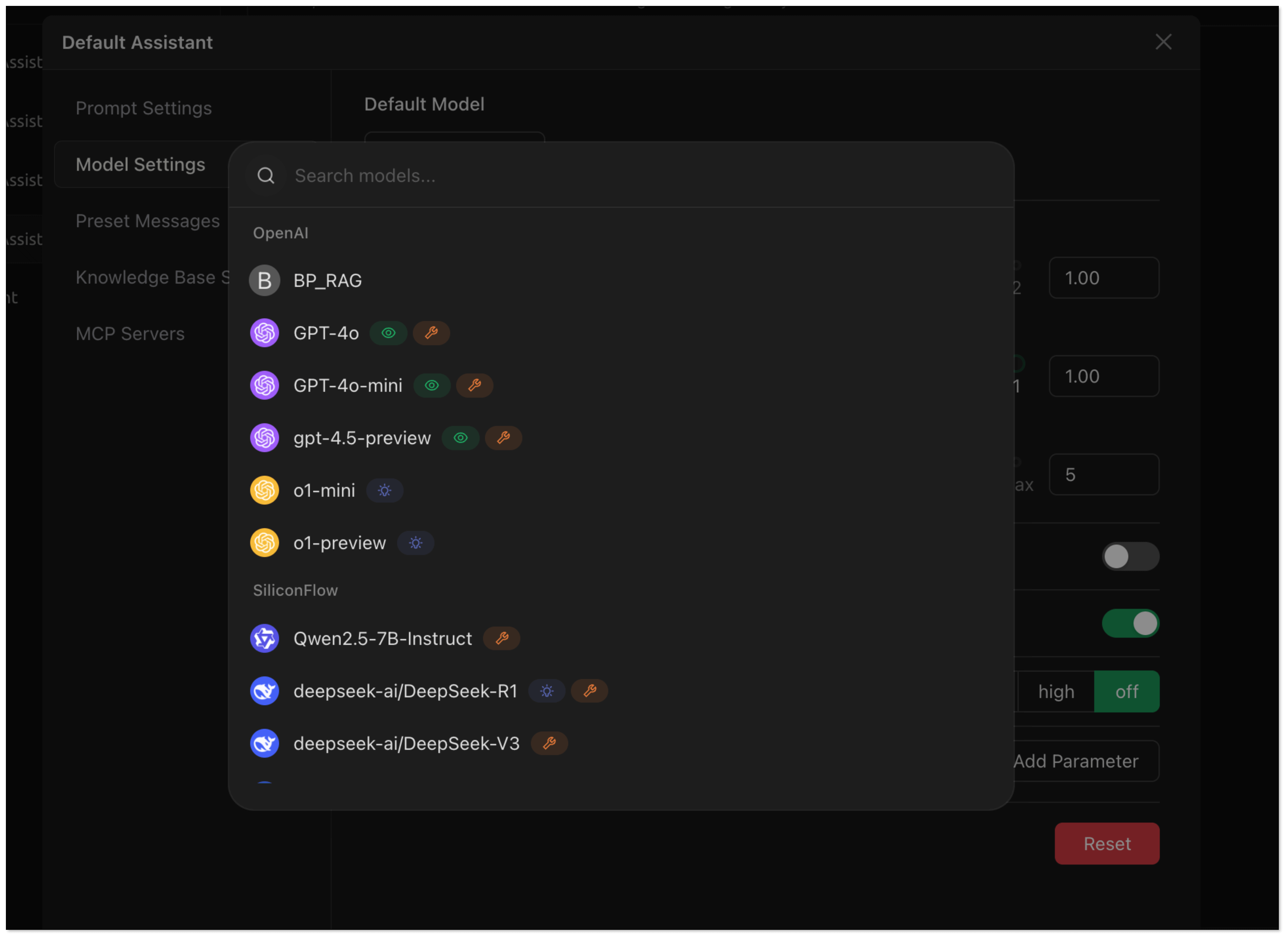
- Back on the chat page:
- Click Add Assistant > Default Assistant.
- Right click Default Assistant > Edit Assistant > Model Settings, and choose BP_RAG as the default model.
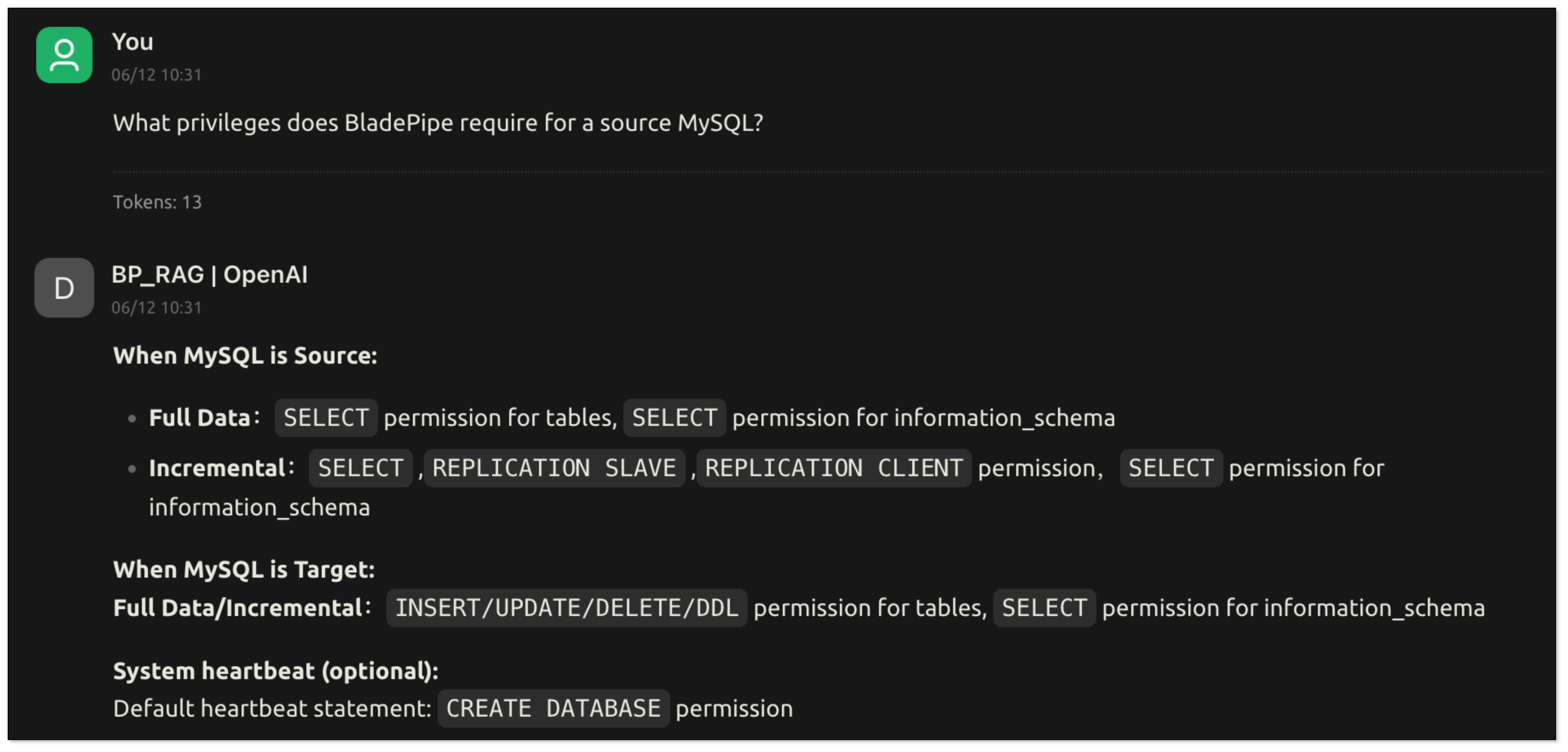
- Now try asking:
What privileges does BladePipe require for a source MySQL?. RagApi will search your vector database and generate a response using the chat model.
Final Thoughts
Enterprise-grade RAG services prioritize data privacy and control. By combining BladePipe with Ollama, you can easily achieve a fully private RAG service deployment, creating a truly reliable enterprise-grade RAG solution that does not depend on public networks.