SQL Server CDC on Always On Readable Replicas: Offload Sync From the Primary

When you use SQL Server as a source for a data pipeline, the same three questions almost always come up: Will synchronization add load to the primary? Can the sync account's privileges be kept to an absolute minimum? Can we reuse the high-availability architecture we already run? An earlier article looked at this for Oracle standby databases; SQL Server raises the same concerns, and the answer is just as clean.
SQL Server CDC pushes incremental changes from the transaction log into a capture process, which writes them to CDC change tables. During the incremental phase, your sync task reads those CDC change tables and their metadata.
If you already run Always On Availability Groups, you can move that read workload onto a readable secondary replica. The primary keeps doing what it does best — business writes and CDC capture — while the sync task consumes CDC data from the replica using a read-only account. The result is less load on your core database, a tighter permission model, and a HA setup you don't have to duplicate.
TL;DR
- Capture stays on the primary; reads move to the replica. SQL Server CDC capture is still performed by the primary replica. The optimization is routing the sync task's continuous reads of the CDC change tables to a readable secondary.
- The replica sees the CDC tables. Change tables and CDC metadata are replicated to the secondary through Always On log transport and redo, so a tool connected to the replica can consume them directly.
- Least privilege at runtime. With static CDC, the DBA pre-creates the capture instances (in the
db_schema_table_cc_staticformat) once on the primary. The sync account then needs onlySELECTon the business schema and thecdcschema — nosysadminordb_ownerat runtime. - Per-table checkpoints. Each table's
_CTchange table is consumed with its own LSN /__$seqvalposition, avoiding duplicate reads and making lag easy to pinpoint. - For production-grade, real-time SQL Server CDC without the operational heavy lifting, BladePipe supports this static-CDC-from-replica mode out of the box.
How SQL Server CDC Incremental Reading Works
The entry point for incremental reading is not the business table itself. It's the capture instance and its corresponding CDC change table that SQL Server creates when you enable CDC on a table.
Every CDC-enabled source table gets its own change table, conventionally named cdc.<capture_instance>_CT. When an INSERT, UPDATE, or DELETE hits the business table, the change is first written to the SQL Server transaction log. The SQL Server Agent CDC capture job then mines the log and writes the change into the matching _CT table.
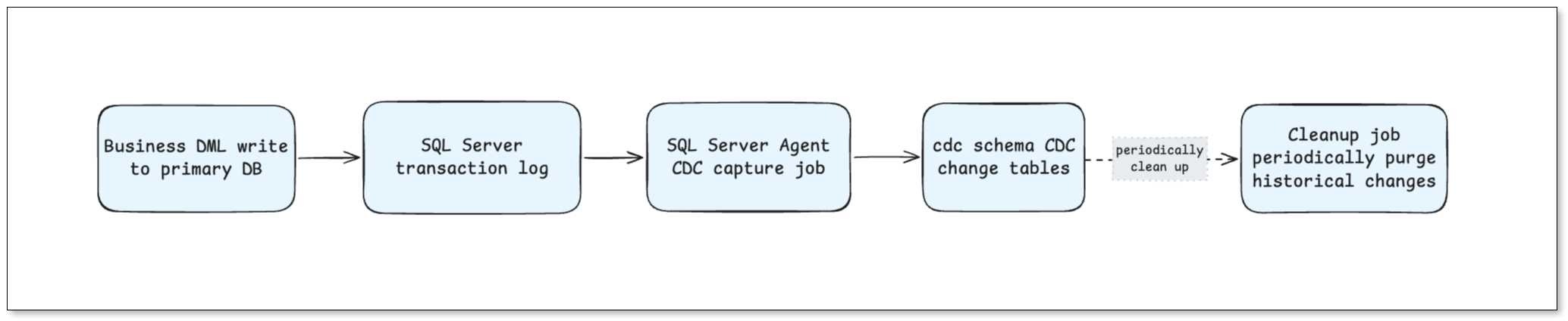
When the sync task consumes incremental data, it reads several objects under the cdc schema:
cdc.<capture_instance>_CT— stores the DML changes for the source table. This is the core data source.cdc.change_tables— records the capture instance, source table, and starting LSN, used to identify CDC tables and the readable range.cdc.captured_columns,cdc.index_columns,cdc.ddl_history— metadata used to identify captured columns, index columns, and DDL history.
Inside each _CT row, alongside the business columns, are several CDC-specific fields:
__$start_lsn— the commit LSN of the transaction the change belongs to. This is the main position used to advance incremental reading.__$seqval— the operation sequence within the same LSN, used to order multiple changes that share a commit.__$operation— the operation type:1= delete,2= insert,3= before-update image,4= after-update image.__$update_mask— a bitmask identifying which columns anUPDATEtouched.
So the essence of SQL Server CDC incremental reading is: consume rows from the _CT table in the order defined by __$start_lsn, __$seqval, and __$operation, and translate the insert/delete and before/after update images into change events the downstream system can apply.
Reading CDC From an Always On Readable Replica
Under Always On, CDC capture still happens on the primary replica. Business DML is written to the transaction log, the SQL Server Agent capture job mines the log and writes changes into the CDC change tables on the primary, and a cleanup job purges historical changes according to the configured retention period.
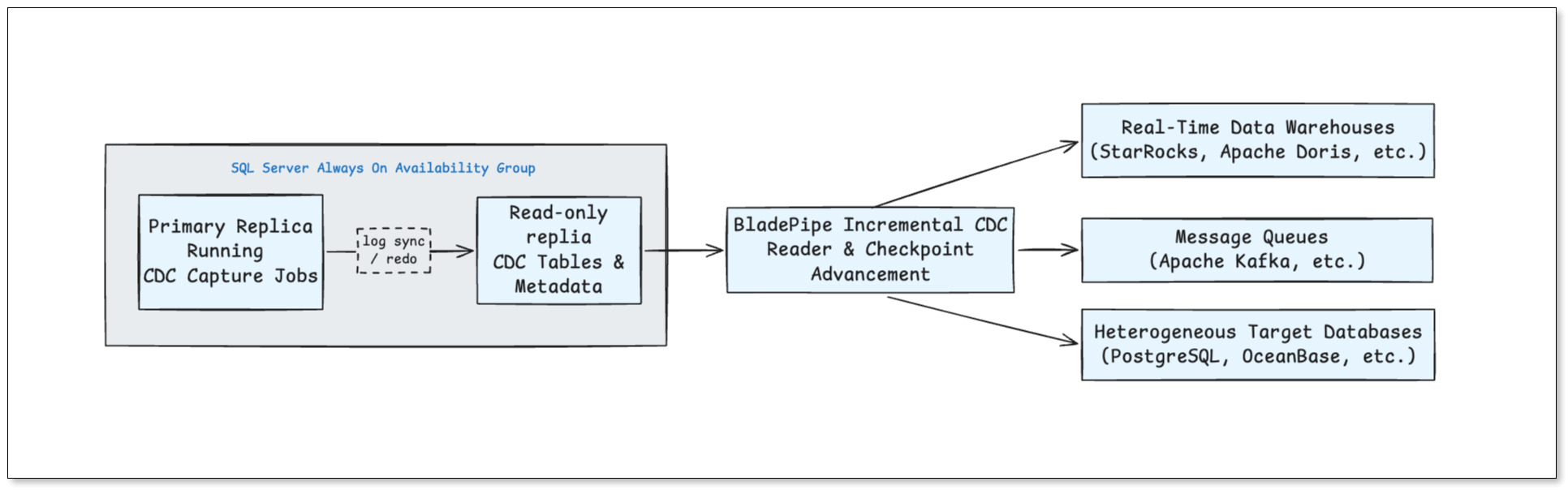
Those CDC change tables and their metadata are then made visible on the readable secondary through Always On log transport and redo. A sync tool connected to the readable replica reads the already-replicated cdc.<capture_instance>_CT, cdc.change_tables, and related objects to complete incremental consumption.
The key insight: the optimization isn't about changing how CDC is captured — it's about moving the sync task's continuous queries against the CDC tables off the primary and onto the readable replica. The primary keeps handling business writes and CDC capture; the secondary serves the CDC reads the sync pipeline needs.
Static CDC and Least-Privilege Operation
Enabling SQL Server CDC requires elevated privileges up front. Database-level CDC needs the sysadmin server role, and table-level CDC / capture-instance creation needs db_owner. These are one-time setup operations, normally performed by a DBA on the primary.
Static CDC means the DBA pre-creates all CDC-related objects in advance, so the sync task never dynamically creates capture instances at runtime — it only consumes the CDC tables and metadata that are already prepared.
In this mode, the DBA pre-creates the CDC capture instances for the subscribed tables in a fixed format, db_schema_table_cc_static. From that point on, the sync account needs only SELECT on the business schema and the cdc schema to continuously consume CDC data — no write or administrative privileges required at runtime.
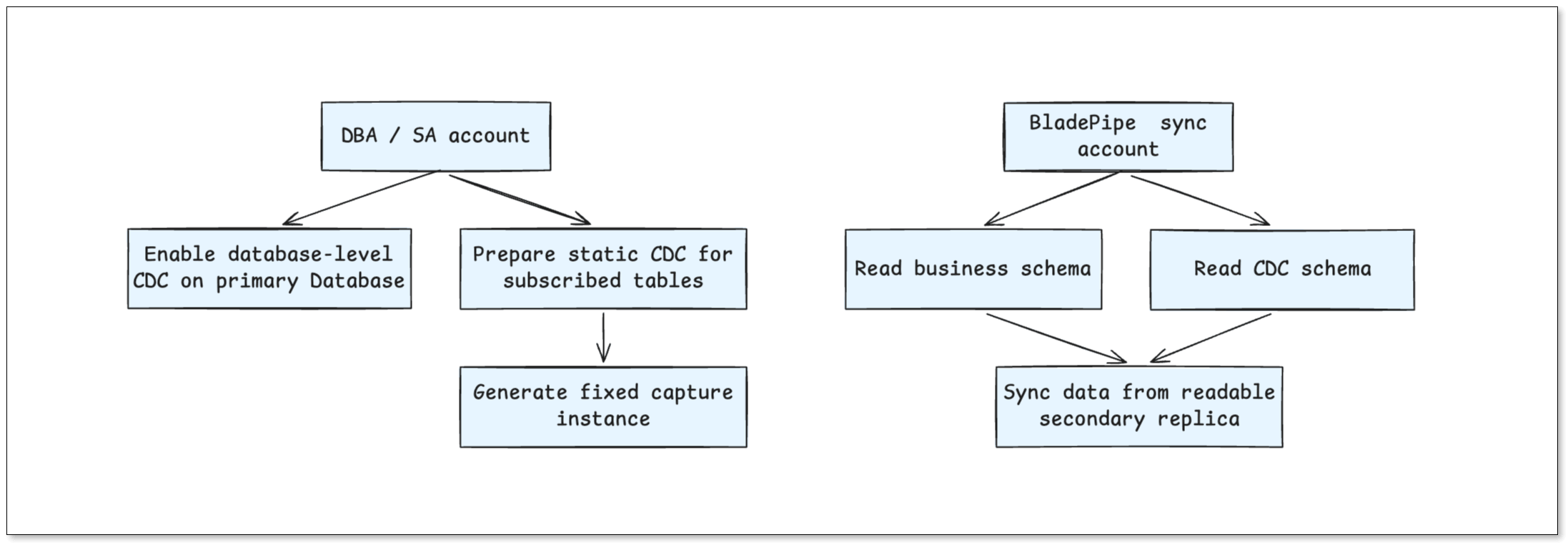
This privilege model is ideal for core databases. The sync account never needs to hold sysadmin or db_owner long term; keeping read-only access during normal operation is enough. On a production SQL Server with strict permission audits, this is often the deciding factor in whether a CDC pipeline is allowed to ship at all. For the exact grant statements a read-only source account needs, see Required Privileges for SQL Server.
Per-Table, Multi-Checkpoint Advancement
In SQL Server CDC, every table has its own independent _CT change table, so different tables naturally progress at different rates. If you maintained only a single global LSN across all tables, the sync task would end up re-reading data it had already consumed.
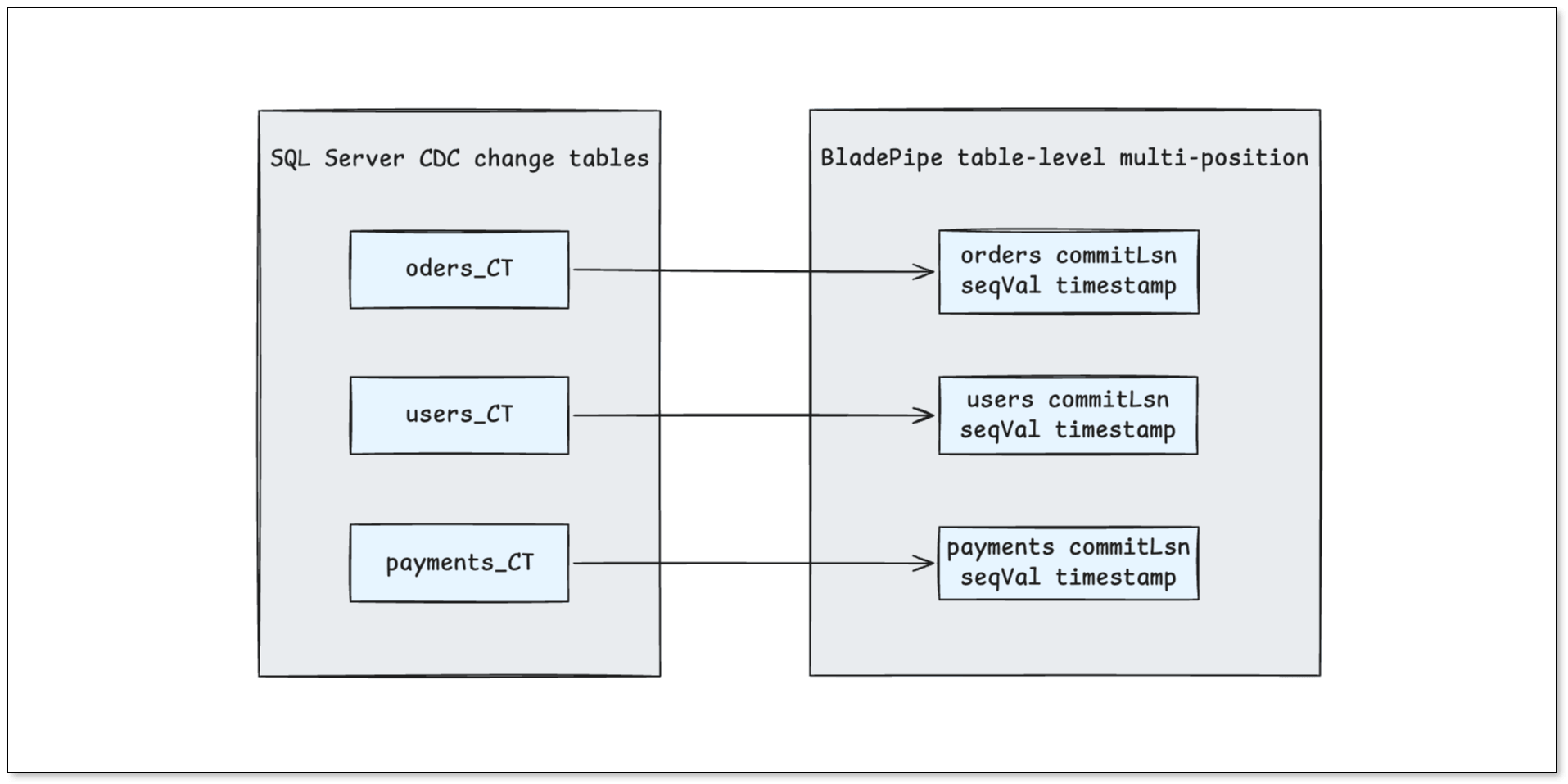
The multi-checkpoint mechanism solves this by tracking progress independently per table. Each table's checkpoint records the LSN it has read up to and the __$seqval, and combines that with __$operation when reading the change table:
- LSN — the log sequence number, which locates the transaction boundary.
__$seqval— the sequence value for multiple changes within the same LSN, used to order operations inside a single transaction.__$operation— the operation type (1= delete,2= insert,3= before-update,4= after-update).
This pays off in real operating scenarios — multi-table subscriptions, task pause and resume, CDC table backlogs. With per-table checkpoints, it's immediately obvious which table has read to where, and which table is falling behind, instead of debugging a single opaque global position.
When to Choose This Architecture
Reading SQL Server CDC from an Always On readable replica with static CDC is a strong fit when:
- The primary is load-sensitive. You don't want continuous CDC read queries competing with business writes on the core database.
- Permissions are tightly audited. Security policy won't allow a sync account to hold
sysadminordb_ownerfor day-to-day operation, so a read-only runtime account is a hard requirement. - You already run Always On. Reusing the existing HA topology avoids standing up a separate replication path just for CDC.
- You need long-running, stable CDC pipelines. Least privilege plus replica offload is a more sustainable posture for core systems than a high-privilege account hammering the primary.
Conversely, if you have no readable secondary and no strict privilege constraints, dynamic CDC on the primary is simpler to set up. The replica + static CDC pattern earns its keep precisely on the databases where it matters most.
Conclusion
In a SQL Server Always On environment, CDC capture is still performed by the primary replica, while incremental synchronization connects to a readable secondary to read the CDC change tables.
This lets you reuse your existing high-availability architecture, keeps the sync read workload off the primary, and lets the runtime account stay read-only. For core SQL Server databases that are sensitive to primary load and strict about permissions, this is a more sustainable way to run CDC synchronization over the long term.
If you'd like to run SQL Server CDC this way without building and operating the plumbing yourself, BladePipe supports static-CDC reads from an Always On readable replica out of the box — with upsert, delete, schema-evolution handling, and built-in monitoring. You can start a free trial or book a live demo for an architecture review.
You may also want to read:
- SQL Server CDC: What Is It and How to Implement It
- Change Data Capture (CDC): A Complete Guide
- Best Data Replication Tools for SQL Databases
FAQ
Q: Can you read SQL Server CDC from a standby / secondary replica?
Yes, with one condition: the replica must be readable, which is the normal configuration for an Always On secondary replica (and for read-scale availability groups). CDC change tables and metadata are replicated to the secondary through Always On log transport and redo, so a tool connected to the secondary can consume them. A traditional non-readable standby mirror won't work for this.
Q: Does reading CDC from the replica change how capture works?
No. SQL Server CDC capture is still performed by the primary replica. Moving reads to the secondary only redirects the sync task's continuous queries against the CDC tables; it does not change the capture mechanism, the capture job, or the cleanup job.
Q: What privileges does the sync account need at runtime?
With static CDC, the runtime account needs only SELECT on the business schema and the cdc schema. The one-time CDC setup (enabling database- and table-level CDC and creating the db_schema_table_cc_static capture instances) requires sysadmin / db_owner and is done by the DBA once on the primary.
Q: Why track a separate checkpoint per table instead of one global LSN?
Each table's _CT change table is independent, so tables progress at different rates. A single global LSN would force the task to re-read already-consumed data. Per-table checkpoints (LSN + __$seqval, combined with __$operation) avoid duplicates and make per-table lag easy to diagnose.
Q: How does this compare to running CDC directly on the primary?
Running CDC reads on the primary is simpler to set up but adds continuous read load to the core database and typically needs a higher-privilege account for dynamic CDC. Reading from an Always On readable replica with static CDC trades a little setup complexity (DBA pre-creates capture instances) for lower primary load and a read-only runtime account — the better long-term posture for core databases.