8 Best Data Replication Solutions for Enterprise and Legacy Systems in 2026

If you are comparing data replication solutions in 2026, start with this shortlist: BladePipe for low-overhead real-time CDC, Oracle GoldenGate for complex Oracle and legacy estates, AWS DMS for AWS migrations, Fivetran for managed warehouse loading, Qlik Replicate for enterprise heterogeneous replication, Hevo for no-code cloud ingestion, Integrate.io for low-code data ops, and Airbyte for open-source connector flexibility.
The right choice depends on whether you need to support legacy systems, reduce source-database load, meet compliance requirements, run across hybrid or multi-cloud environments, or keep analytics and operational systems synchronized in near real time.
If your project is specifically about replication between relational databases such as SQL Server, MySQL, PostgreSQL, or Oracle, see our more focused guide to SQL database replication tools.
Quick Recommendations
For most teams evaluating data replication solutions, the practical answer is:
| Use case | Recommended tool | Why it fits |
|---|---|---|
| Real-time replication with low source impact | BladePipe | Log-based CDC, full + incremental sync, verification workflows, and cloud/on-prem deployment |
| Oracle-heavy enterprise and legacy estates | Oracle GoldenGate | Mature log-based replication, strong HA options, and broad Oracle support |
| AWS migration and ongoing replication | AWS DMS | Native AWS service for cloud migration, replication, and modernization |
| Enterprise heterogeneous replication with governance | Qlik Replicate | Broad database support, monitoring, and enterprise management |
| Managed replication into cloud warehouses | Fivetran | Fully managed connectors, automated schema handling, and low ops overhead |
| No-code cloud ingestion with transformation | Hevo Data | Simple setup, transformations, and fast delivery for analytics teams |
| Low-code data pipelines with observability | Integrate.io | Rich transformation layer, alerts, and governance-friendly workflows |
| Open-source and self-managed flexibility | Airbyte | Large connector ecosystem with self-hosted and cloud deployment options |
If your main question is "which companies offer reliable data replication services for legacy systems or hybrid environments?", start by filtering vendors based on CDC approach, source-system impact, compliance controls, deployment model, and recovery behavior after schema changes.
Which Data Replication Solution Fits Your Scenario?
Different replication projects fail for different reasons. The best tool for a warehouse sync project may be the wrong tool for a low-latency operational workload or a regulated legacy migration.
Best for legacy systems and enterprise modernization
If you are moving data out of older Oracle, SQL Server, DB2, or mixed on-prem environments, look for tools with proven log-based capture, heterogeneous targets, and strong failure recovery. Oracle GoldenGate, Qlik Replicate, AWS DMS, and BladePipe are usually the first tools to evaluate in these cases.
Best for minimal source-system performance impact
This is where log-based change data capture matters most. Instead of repeatedly scanning full tables, the tool reads transaction logs, binlogs, write-ahead logs, or redo logs. That usually leads to lower source load and better freshness. BladePipe, Oracle GoldenGate, Qlik Replicate, and AWS DMS are stronger fits here than batch-heavy approaches. If you want a more implementation-level shortlist, review these CDC tools for real-time replication.
Best for compliance, governance, and controlled deployment
Enterprises often need encryption, access control, auditability, and the option to keep data inside a VPC or on-prem environment. BYOC, self-hosted, or on-prem deployment options can matter as much as latency. GoldenGate, Qlik Replicate, BladePipe, and Integrate.io are better starting points when governance is a first-class requirement.
Best for hybrid cloud and multi-cloud replication
If your environment spans on-prem databases plus AWS, Azure, Google Cloud, Kafka, or warehouses, prioritize connector breadth and deployment flexibility. Qlik Replicate, BladePipe, AWS DMS, and Airbyte are worth comparing first, depending on how much operations work your team is willing to own.
Best for analytics and warehouse ingestion
If your primary goal is moving data into Snowflake, BigQuery, Redshift, or Databricks with minimal maintenance, managed ELT platforms such as Fivetran and Hevo are often easier to operate than enterprise replication middleware. This usually becomes part of a broader data transformation services strategy rather than a pure SQL replication project.
Modern Data Replication Solutions
As data environments have evolved, so too have the solutions designed to sync them. Today, modern replication tools are usually evaluated by deployment model, latency, operational overhead, and fit for legacy, cloud, or real-time workloads.
For Cloud Environments
The shift to the cloud has birthed new replication solutions built specifically for distributed, scalable architectures.
- Cloud-Native Managed Services: These are SaaS-based data replication solutions that operate entirely in the cloud. They require zero infrastructure management, scale automatically, and specialize in moving data from various SaaS apps and on-premise databases into cloud data warehouses (like Snowflake, BigQuery, or Redshift).
- Multi-Cloud and Hybrid Replication: Many enterprises don't rely on just one cloud provider. Hybrid solutions allow data to flow seamlessly from an on-premise legacy Oracle database into an AWS environment, or from Azure to Google Cloud, ensuring high availability and avoiding vendor lock-in.
For Real-Time Replication
Historically, data was replicated in nightly batches (ETL). Today, businesses need to make decisions by the second. That birthed the solutions for real-time needs.
- Change Data Capture (CDC): CDC is the gold standard for real-time data replication. Instead of copying entire tables, CDC tools capture only changes by reading the database's transaction logs, and then deliver them to the target instantly. This results in ultra-low latency (often sub-second) and minimal impact on the source's performance.
- Streaming Replication: Utilizing message brokers like Apache Kafka, these solutions stream continuous flows of data across systems, ideal for real-time analytics, fraud detection, and live operational dashboards.
How to Choose the Right Tool
With dozens of tools on the market, selecting the right one requires a strategic evaluation of your business needs. Consider the following criteria:
- Latency Requirements: Do you need real-time data for operational dashboards, or are hourly/daily batch updates sufficient for your analytics? If you need real-time, prioritize tools with strong Log-based CDC capabilities.
- Source-System Impact: Ask how the tool captures changes. Log-based CDC usually places less load on production systems than repeated table scans or custom queries.
- Source and Target Connectors: Audit your current data stack. The right tool should have pre-built, native connectors for your specific databases, SaaS apps, and data warehouses.
- Ease of Use: Does the tool require a team of specialized data engineers to write complex code, or does it offer an intuitive, no-code/low-code visual interface? In most cases, a simple, automated tool is better considering the long-term maintanence cost.
- Deployment Options: Determine if your compliance team requires you to keep data entirely within your own Virtual Private Cloud (BYOC/Self-hosted) or if a fully managed SaaS solution is acceptable.
- Legacy and Hybrid Support: If you are modernizing older systems, verify support for mixed database estates, schema drift, and heterogeneous targets before committing.
- Recovery and Verification: Replication tools should help you validate row counts, recover from connector failures, and surface schema issues before downstream users notice broken data.
- Pricing Model: Pricing structures vary wildly. Some charge by the volume of data processed, which can may be expensive as data scales. Others charge a flat rate per connector or pipeline. Choose a model that aligns with your projected data growth.
8 Data Replication Tools Worth Considering
Based on performance, scalability, ease of use, and feature sets, here is a curated list of data replication solutions for enterprise, hybrid, and real-time workloads in 2026.
1. BladePipe
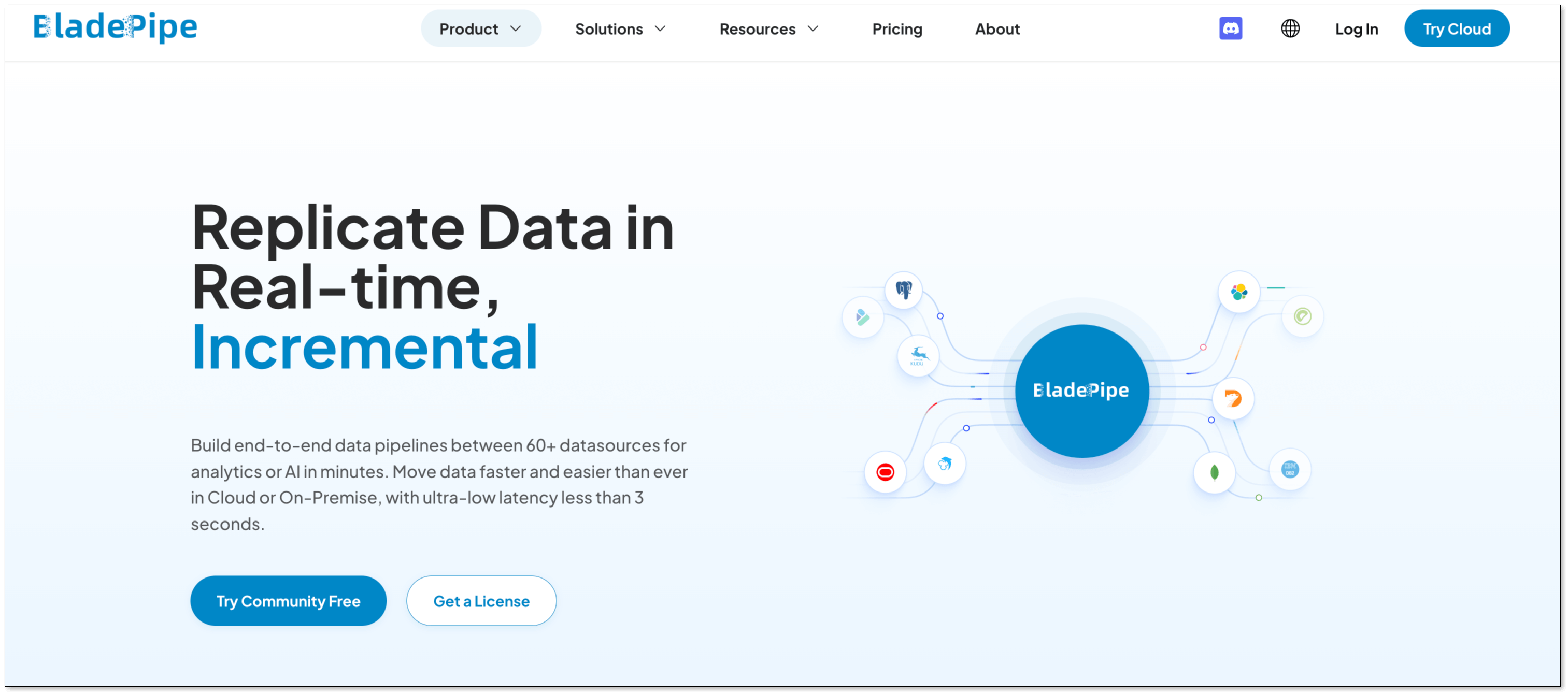
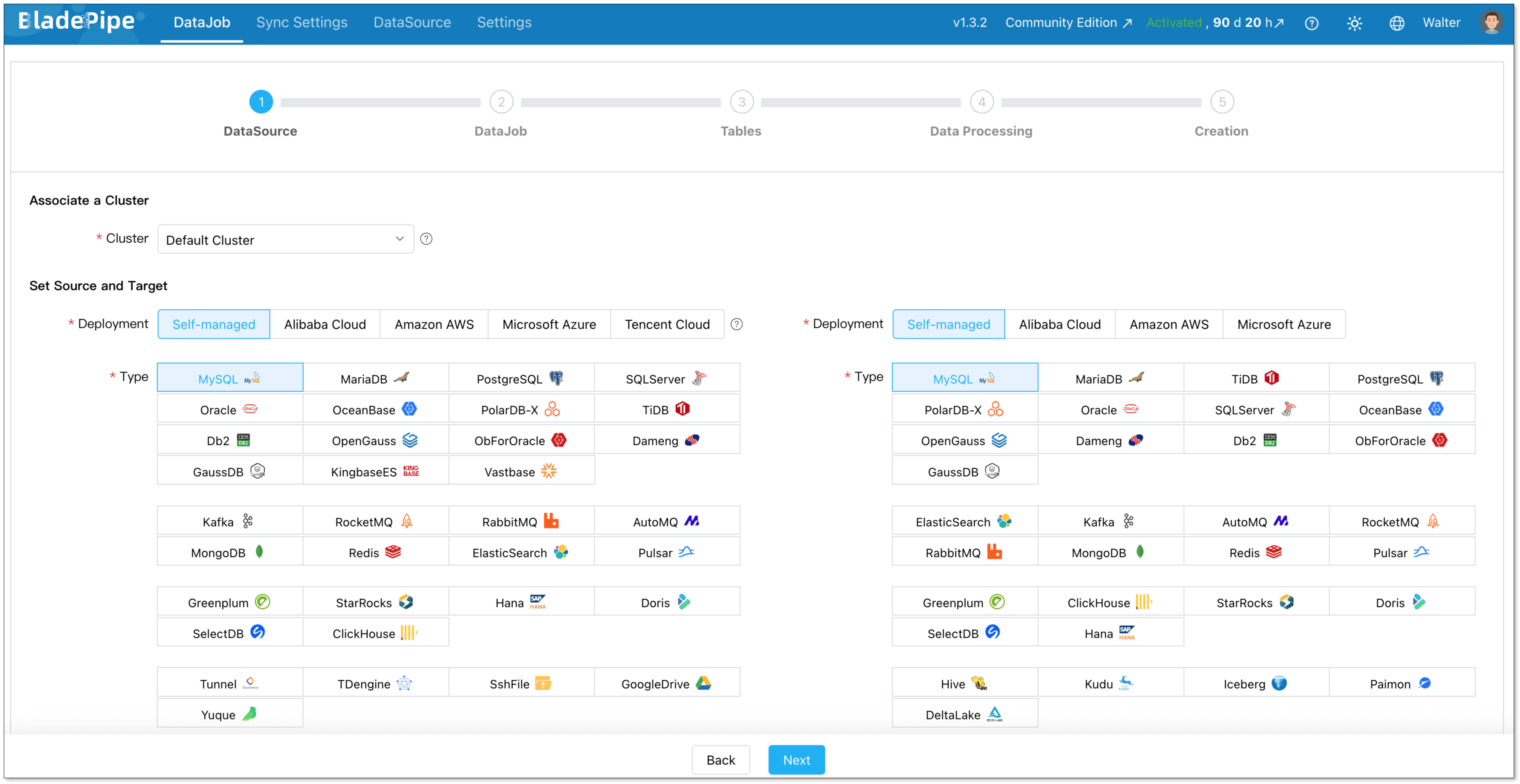
BladePipe is a modern, high-performance solution specializing in real-time Change Data Capture (CDC). It is designed for teams that prioritize ultra-low latency, reliability and automation. With an intuitive UI, even non-engineers can build and manage pipelines in minutes.
Features:
- Real-time Delivery: Captures row-level changes without impacting source performance.
- Automated Schema Evolution: Automatically handles DDL changes and table migrations.
- Transformation Variety: Provides various built-in transformations and flexibility with Java custom code.
- Deployment Flexibility: Offers fully managed Cloud SaaS, BYOC, and On-Premise options.
- Ease of Use: All operations can be done through clicks in the interface.
- Free Community: Self-hosted. For new users, you'll get the tool activated for 15 days automatically. Then you'll need to renew free license every 3 months.
- Cloud: Pay-as-you-go pricing model. Start at $0.01 for every million rows of data. It is pre-paid based and you'll get the bill every day, ensuring the maximum cost predictability.
- Enterprise: Quote-based pricing model. Contact the sales team for a price tailored to your specific needs.
Limitations to consider: Like any CDC platform, BladePipe still depends on proper source permissions and log access. Teams should confirm readiness for MySQL binlogs, PostgreSQL logical replication, SQL Server CDC, or Oracle log capture before rollout.
2. Fivetran
Fivetran is a fully managed, cloud-native data replication tool that automates ETL process. With a massive library of over 700 fully managed connectors, Fivetran is used by many companies for centralizing data from SaaS applications into cloud data warehouses for analytics.
Best for: Analytics teams that want managed replication into cloud warehouses with minimal day-to-day operations.
Features:
- 700+ Connectors: The largest library of pre-built integrations in the market.
- Automated Schema Management: Automatically adjusts target tables when source schemas change.
- High Availability: Managed infrastructure ensures 99.9% uptime.
Pricing:
Fivetran pricing is based on Monthly Active Rows (MAR). That means you pay based on the number of unique rows updated or inserted each month across your connectors. Such a pricing model makes costs highly unpredictable.
Besides, since Jan, 2026, users have to pay a $5 base charge per connection for usage under 1M MAR, then scales with volume.
3. Oracle GoldenGate
Oracle GoldenGate is a robust software suite for real-time data integration, providing sub-second latency for large-scale enterprise data fabrics. It offers transactional consistency and extreme performance, often used in financial services, telecom, and large enterprises.
Best for: Large organizations with Oracle-heavy or legacy estates that need mature enterprise replication.
However, it is a complex middleware solution that requires specialized engineering expertise to configure, manage, and troubleshoot, making it overkill for smaller or purely cloud-native analytics setups.
Features:
- Extreme Performance: Capable of handling millions of transactions per second.
- High Scalability: Supports petabyte-scale databases.
- Bidirectional Sync: Enables active-active database configurations for zero downtime.
Pricing:
- OCI GoldenGate (Standard): $1.3441 per OCPU/hour
- OCI GoldenGate (BYOL): ~$0.3226 per OCPU/hour.
4. AWS Database Migration Service
AWS Database Migration Service is a managed AWS service for migrating and replicating databases into AWS. It supports both one-time migrations and ongoing replication across common relational engines and AWS targets.
Best for: Teams moving databases into AWS or modernizing legacy workloads on RDS, Aurora, Redshift, or S3.
Features:
- Managed AWS Service: Native integration with IAM, networking, monitoring, and target services.
- Migration plus Replication: Supports full migration, continuous replication, and phased modernization.
- Heterogeneous Paths: Useful for moves such as Oracle to Aurora PostgreSQL or SQL Server to Amazon RDS.
Pricing:
AWS DMS pricing depends on the replication instance, storage, logs, and related AWS resources. Cost is usually reasonable for AWS-centered projects but can rise once multiple services are involved.
If AWS is one of your top options, this deeper comparison of AWS DMS vs BladePipe can help clarify trade-offs between migration-first and CDC-first approaches.
5. Qlik Replicate
Qlik Replicate is enterprise database replication software designed for large-scale heterogeneous data movement. It is frequently used for cloud migration, data warehouse loading, and real-time data delivery across mixed enterprise systems.
Best for: Large enterprises with many source systems, governance requirements, and a need for broad platform coverage.
Features:
- Broad Database Support: Strong fit for heterogeneous replication across on-prem and cloud systems.
- Enterprise Monitoring: Centralized management and monitoring for large estates.
- Mature CDC: Well-established replication capabilities for warehouse and migration programs.
Pricing:
Qlik Replicate uses enterprise pricing that typically requires a sales conversation. Teams should expect higher procurement and implementation effort than lighter-weight cloud tools.
6. Hevo Data
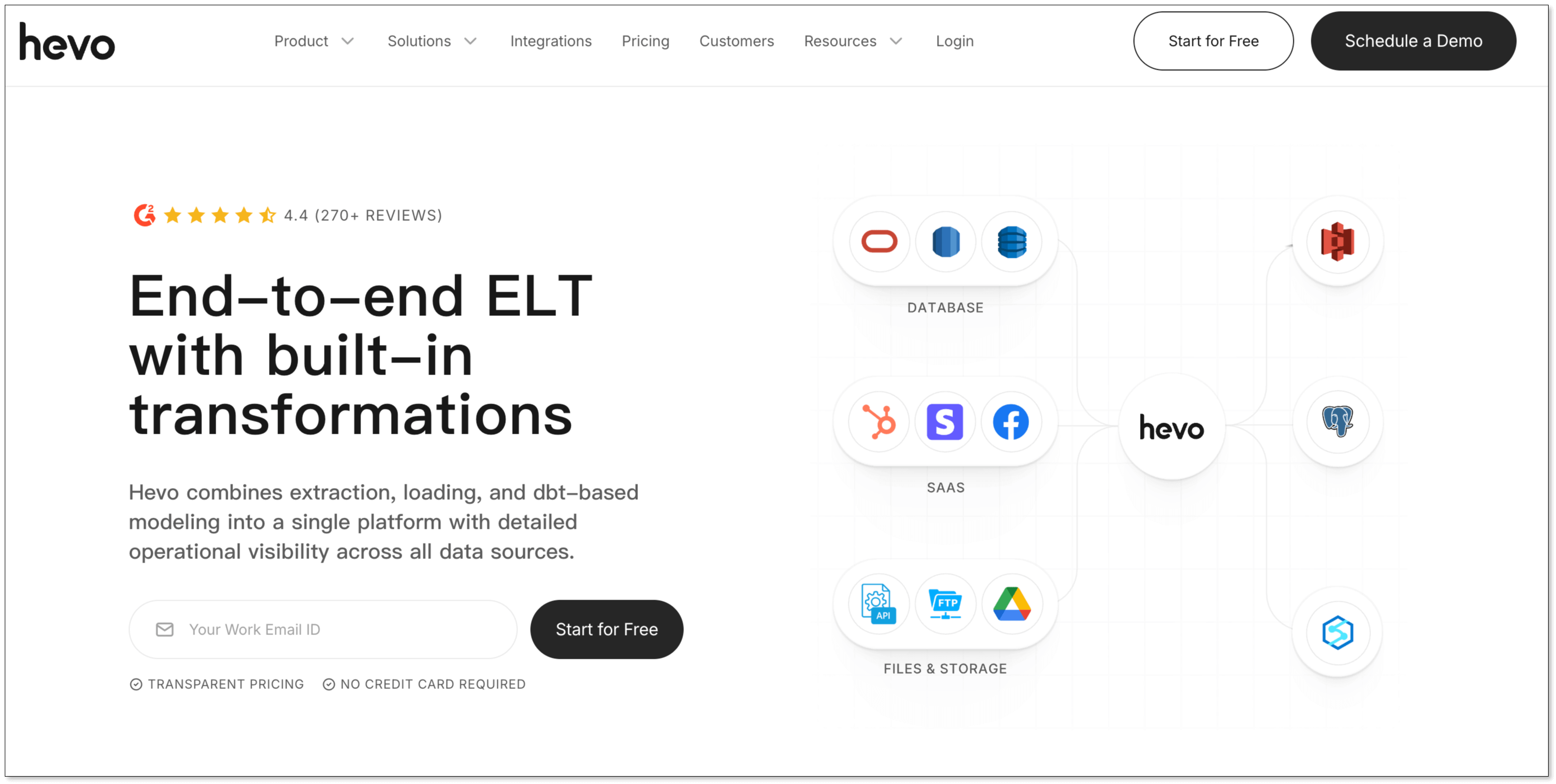
Hevo is a user-friendly, no-code platform that bridges the gap between simple SaaS integration and complex database replication. It supports over 150 integrations, and provides both ETL and ELT capabilities, allowing users to cleanse and shape data before it hits the warehouse.
Best for: Small and midsize analytics teams that want fast setup and managed cloud ingestion.
Features:
- Python Transformations: Allows users to write custom logic in-flight using Python.
- Reverse ETL: Move data from your warehouse back into operational tools.
- Real-Time Monitoring: Granular dashboards to track pipeline health.
Pricing:
- Free: Free to use for up to 1 million events and limited connectors.
- Starter: Start at $299/month for up to 5 million events ($239 if billed annually).
- Professional: Start at $849/month for up to 20 million events ($679 if billed annually).
- Business Critical: Quote-based pricing.
7. Integrate.io
Integrate.io is a low-code data integration platform that focuses on making ETL, ELT, and Reverse ETL accessible to non-engineers. It features powerful in-pipeline data engine transformations, allowing you to prep and clean data before it reaches the warehouse, saving on cloud computing costs at the destination.
Best for: Teams that want low-code pipelines, observability, and transformation-heavy workflows.
Features:
- Visual UI: Drag-and-drop interface with 220+ transformation operations.
- Data Observability: Built-in alerts to identify data quality issues before they reach the warehouse.
- Data Security: Strong compliance including HIPAA, GDPR, and SOC 2.
Pricing:
- Core: $1,999/month
8. Airbyte
Airbyte is an open-source data integration platform with a large connector ecosystem and both self-managed and cloud deployment options. Teams often evaluate it when open-source flexibility matters more than fully managed convenience.
Best for: Teams that want open-source control, broad connector coverage, and self-managed deployment options.
Features:
- Large Connector Catalog: Broad source and destination coverage across databases, APIs, and warehouses.
- Deployment Flexibility: Self-hosted and cloud offerings support different governance models.
- Active Ecosystem: Fast-moving connector development and community contribution.
Pricing:
Airbyte offers open-source self-hosted usage plus cloud pricing. Total cost depends heavily on connector maturity, operations ownership, and workload volume.
Quick Comparison of Tools
| Feature / Tool | BladePipe | Fivetran | Oracle GoldenGate | AWS DMS | Qlik Replicate | Hevo Data | Integrate.io | Airbyte |
|---|---|---|---|---|---|---|---|---|
| Deployment | Cloud/On-prem | Cloud | Cloud/On-prem | Cloud | Cloud/On-prem | Cloud | Cloud | Cloud/On-prem |
| Primary strength | Real-time CDC | Managed warehouse sync | Enterprise Oracle replication | AWS migration | Enterprise heterogeneous replication | No-code cloud ingestion | Low-code pipelines | Open-source flexibility |
| Latency | < 3 seconds | > 1 minute | Sub-second | Near real-time | Near real-time | > 1 minute | 60-second CDC / Batch | Varies by connector |
| Legacy / hybrid fit | High | Medium | High | High in AWS | High | Medium | Medium | Medium to High |
| Ease of Use | High | High | Medium | Medium | Medium | High | Medium | Medium |
| Pricing Model | Free / pay-as-you-go / enterprise | MAR-based | OCPU/hour or BYOL | AWS resource-based | Quote-based | Free / monthly plans | Starts at $1,999/month | Open source / cloud usage |
Best Practices for Designing Your Data Replication Solution
To ensure your data replication architecture is robust, scalable, and secure, adhere to these industry best practices:
- Embrace Log-Based CDC: Whenever possible, avoid query-based extraction that puts a heavy load on your production databases. Use log-based CDC to read database changes silently and efficiently.
- Automate Schema Evolution: Choose a tool that automatically propagates DDL changes from the source to the target. If a developer adds a new column to a production table, your pipeline should adapt without breaking.
- Implement Strict Data Governance: Migration and replication don't excuse you from compliance. Ensure data is encrypted in transit and at rest. Utilize tools with Role-Based Access Control (RBAC) and robust audit logging.
- Monitor and Alert: Utilize integrated dashboards to monitor data freshness, pipeline latency, and throughput. Set up automated webhook or email alerts for pipeline failures or latency spikes.
- Validate Your Data: Implement automated data verification. Periodically compare row counts and data types between the source and target to guarantee consistency.
Conclusion
The best data replication solution is not always the one with the longest feature list. It is the one that fits your environment, your latency target, your governance requirements, and the operational effort your team can realistically support.
If you are evaluating tools for legacy modernization, hybrid cloud replication, or low-overhead real-time CDC, start with a proof of concept that includes your largest tables, your most annoying schema changes, and a realistic failure-recovery test. If your next step is selecting a destination for analytics, it also helps to review the difference between a database and a data warehouse. If you want a developer-friendly option that focuses on real-time replication, automatic schema evolution, and flexible deployment, BladePipe is worth evaluating alongside other leading tools in this category.
FAQ
Q: What is the difference between replication and synchronization?
While often used interchangeably, there is a subtle difference. Replication copies data to multiple systems for consistency and availability, while synchronization ensures two systems are identical at all times, sometimes requiring bi-directional updates.
Q: How does schema evolution affect replication?
Schema changes, such as adding or altering columns, can break replication pipelines, causing data loss or downtime until an engineer fixed the mapping. Tools with automatic schema evolution handle these changes seamlessly without manual intervention.
Q: How to choose a reliable data replication service provider?
Look for providers that offer robust SLAs (Service Level Agreements), low source-system impact, strong failure recovery, and the deployment controls your compliance team needs. It is highly recommended to utilize free trials or proof-of-concept projects to test true latency and ease of use in a staging environment before committing.
Q: Are there any affordable data replication tools for small businesses?
Yes. Tools like BladePipe and Hevo provide cloud-based, pay-as-you-go or free-tier options suitable for small businesses with limited budgets.