7 Best Talend Alternatives After Open Studio: ETL, CDC, and Migration

If you are comparing Talend alternatives, you are probably trying to reduce ETL complexity, replace discontinued open-source workflows, lower integration costs, or add stronger real-time CDC.
Many teams are moving away from Talend because of cost, complexity, or licensing changes. Whether you need ETL pipelines, real-time CDC, data migration, or data ingestion at scale, there are better options today.
What Is Talend?
Talend is a data integration platform that has been around since 2006. It supports ETL, data quality, and cloud data pipelines. For a long time, it was one of the go-to tools for enterprise data teams.
In 2023, Qlik acquired Talend. Since then, pricing and licensing have shifted. Some open-source components have been pulled back. The community edition (Talend Open Studio) was fully discontinued. And the paid product is expensive for small to mid-sized teams.
Why Consider a Talend Alternative?
A few common reasons teams start looking elsewhere:
Talend Open Studio changes: The search for a Talend alternative changed after Talend Open Studio was discontinued. Teams that previously relied on the free community edition now need a replacement for open-source ETL jobs, database migration, CDC, or warehouse ingestion.
Cost: Talend's enterprise plans are not cheap. For startups or growing teams, the price-to-value ratio gets hard to justify.
Complexity: Setting up and maintaining Talend jobs takes time. It has a steep learning curve, especially for teams without dedicated data engineers.
Limited real-time CDC: Talend handles batch ETL well, but real-time Change Data Capture (CDC) support is limited compared to newer tools.
Licensing changes: After the Qlik acquisition, some features that used to be free moved behind a paywall. That surprised a lot of existing users.
The right Talend replacement depends on what you are replacing. If you need a broad enterprise data quality and governance suite, tools like Informatica or Qlik may still belong on the shortlist. If you are replacing Talend Open Studio or a small set of Talend jobs, a lighter ETL, ELT, or CDC tool is usually easier to adopt and cheaper to operate.
If any of these sound familiar, it is worth exploring what else is out there.
7 Best Talend Alternatives
1. BladePipe
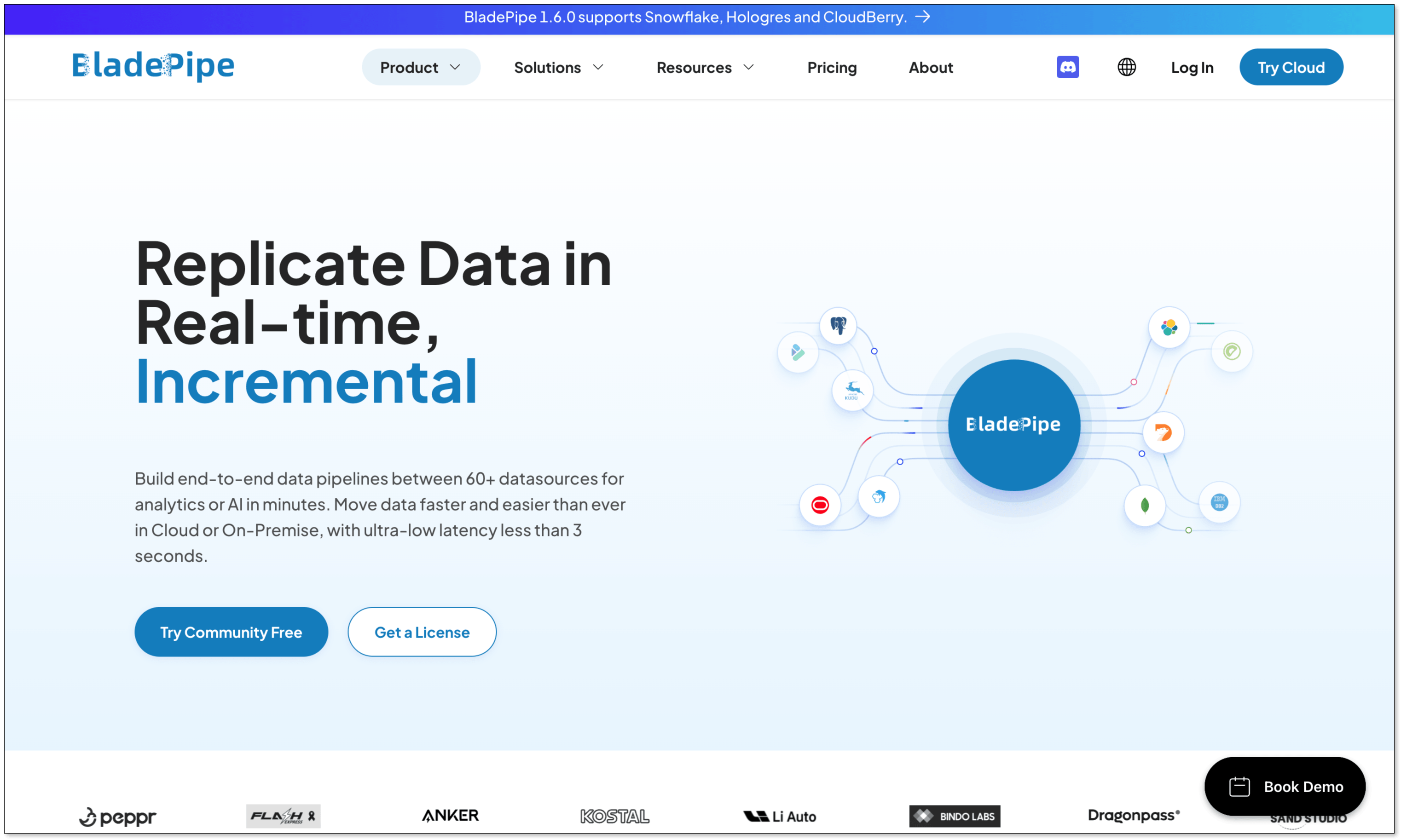
BladePipe is the best Talend alternative if your main focus is real-time data integration, data migration, CDC, and database replication. It covers the full range: ETL, CDC, data migration, and data ingestion. And the best part is it has a fully free version to get started.
Unlike most tools in this space, BladePipe does not hide core features behind a paywall. You get real-time CDC, full data migration support, and a clean UI without paying anything upfront.
BladePipe is not a full Talend governance-suite clone. It is strongest when the Talend workload you want to replace is ETL plus CDC, database migration, replication, or synchronization rather than broad master data management or enterprise data quality governance.
What it does well:
BladePipe supports CDC from databases like MySQL, PostgreSQL, MongoDB, Oracle, and more. Changes are captured at the source and streamed downstream in real time. Setup is fast, and latency is low.
For data migration, BladePipe handles both schema migration and full data sync. You can move data between databases with minimal configuration. It supports cloud, on-premise, and hybrid environments.
The platform also supports ETL transformations in the pipeline. You do not need a separate tool for transformation logic.
Why choose BladePipe:
- Strong fit for real-time CDC
- Good for data migration and synchronization
- Supports full migration and incremental replication
- Useful for database-to-database and database-to-warehouse pipelines
- Includes a fully free option
Best for: Startups, growing data teams, and anyone tired of paying for features they barely use.
Pricing: Free tier available. Paid plans for enterprise-scale usage.
2. Airbyte
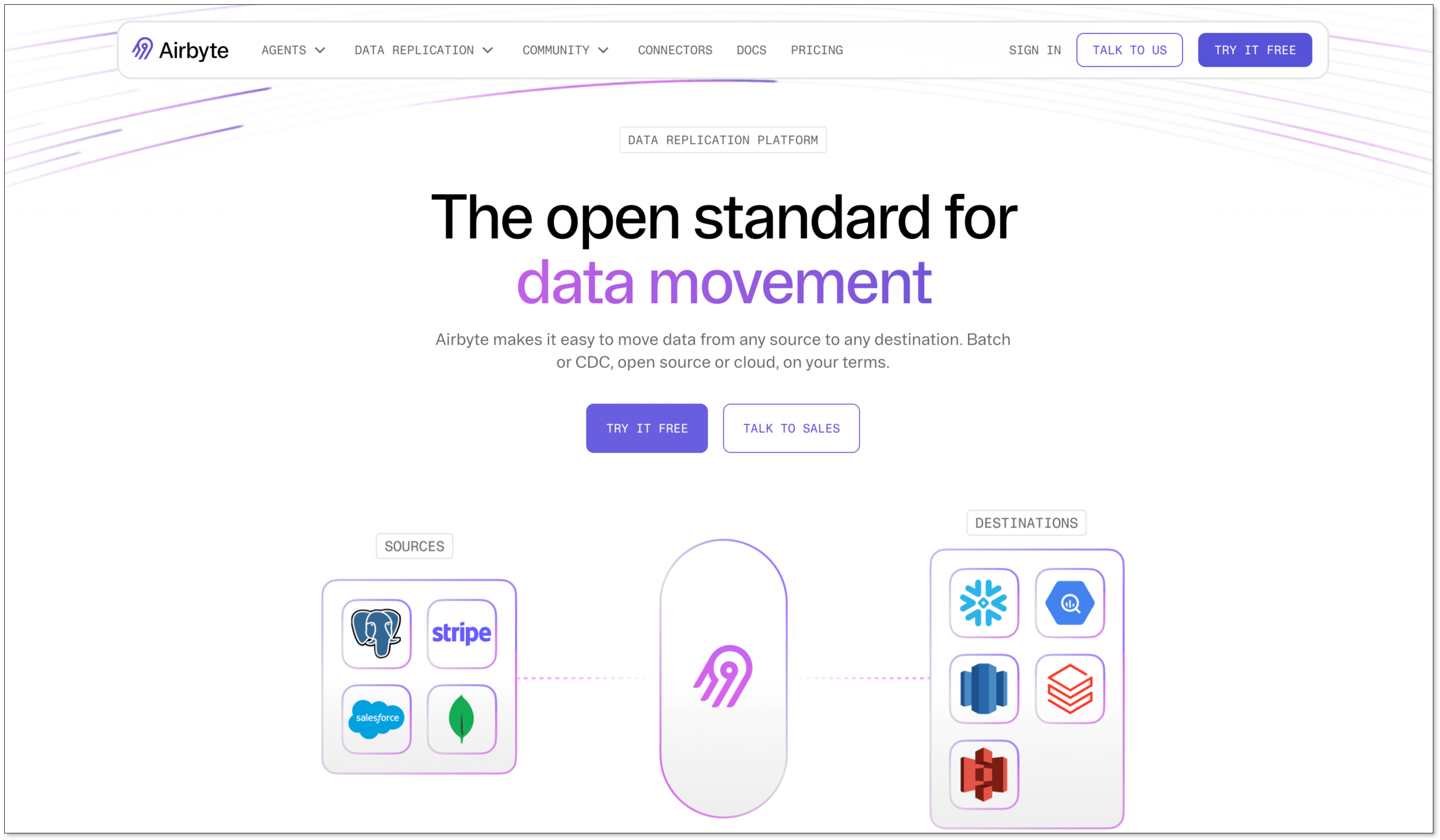
Airbyte is an open-source ELT platform with a large connector library. It focuses on data ingestion from hundreds of sources into your data warehouse or lake.
The community edition is self-hosted and free. Airbyte Cloud is managed but has usage-based pricing. It is a good choice if you want open-source flexibility with a wide connector ecosystem.
CDC support exists but is not its strongest feature. Airbyte shines most for batch ELT and data ingestion use cases.
Why choose Airbyte:
- Open-source option
- Broad connector catalog
- Good for ELT workflows
- Active developer community
Best for: Teams that need many pre-built connectors and prefer open-source software.
Pricing: Free (self-hosted). Airbyte Cloud starts at usage-based pricing.
3. Fivetran
Fivetran is a fully managed ELT tool. It handles data ingestion from SaaS apps, databases, and cloud services with minimal setup. Connectors are maintained by Fivetran, so you do not worry about breaking changes.
Fivetran is reliable and easy to use. It is a strong choice if you want less maintenance. But it is not cheap. Pricing is based on monthly active rows (MAR), which can get expensive as data volume grows.
Fivetran does support CDC for certain database sources. It is a solid option if budget is not a concern and you want something that just works.
Why choose Fivetran:
- Fully managed data pipelines
- Large connector ecosystem
- Strong fit for cloud data warehouses
- Good for SaaS data ingestion
- Low operational burden
Best for: Teams that want a managed, low-maintenance pipeline solution, and don't concern about the budget.
Pricing: No free tier. Starts at several hundred dollars per month depending on volume.
4. Apache Kafka + Kafka Connect

Kafka is the standard for real-time data streaming. Combined with Kafka Connect and Debezium, it becomes a powerful CDC engine. Changes from your source databases stream into Kafka topics and can be consumed by any downstream system.
This is not a plug-and-play tool. It requires infrastructure knowledge and operational overhead. But for teams that need high-throughput, real-time CDC at scale, Kafka is hard to beat.
Why choose Kafka:
- Strong for real-time streaming
- Good for event-driven systems
- Large connector ecosystem
- Works well with Debezium for CDC
- Open-source option
Best for: Engineering teams comfortable managing distributed systems who need real-time event streaming.
Pricing: Open-source and free. Managed versions (Confluent Cloud) are paid.
5. AWS Glue
AWS Glue is a serverless ETL service built into the AWS ecosystem. If your data already lives in S3, Redshift, or RDS, Glue integrates cleanly. You write ETL scripts in Python or Spark, and Glue handles the infrastructure.
It is not the easiest tool to use. Debugging Glue jobs can be frustrating. But for AWS-native teams, it removes the need to manage ETL servers.
CDC support through Glue is limited. It works better for scheduled batch ETL than real-time pipelines.
Why choose AWS Glue:
- Serverless ETL
- Strong AWS integration
- Supports batch and streaming jobs
- Good for data lakes
- Pay-as-you-go pricing
Best for: AWS-centric teams running batch ETL workflows.
Pricing: Pay-per-use based on DPU hours. No upfront cost, but costs can add up.
6. Informatica
Informatica is one of the oldest names in enterprise data integration. It covers ETL, data quality, master data management, and data governance in one platform.
It is feature-rich, but it also comes with enterprise-level pricing and complexity. Smaller teams will likely find it overkill.
For large organizations with strict compliance needs and complex data environments, Informatica still makes sense. But for most teams reading this article, it is probably more than you need.
Why choose Informatica:
- Enterprise-grade data integration
- Strong governance features
- Strong data quality capabilities
- Suitable for hybrid and multi-cloud environments
- Good for regulated industries
Best for: Large enterprises with complex data governance requirements.
Pricing: Enterprise pricing only. Contact sales.
7. Stitch
Stitch is a simple, cloud-based data ingestion tool. It moves data from dozens of sources into your warehouse with very little configuration. Think of it as a lighter version of Fivetran.
It does not support CDC or complex transformations. But if you need a quick, reliable way to load data from common SaaS sources into BigQuery, Snowflake, or Redshift, Stitch does the job well.
Why choose Stitch:
- Simple setup
- Good for SaaS data ingestion
- Works with major cloud warehouses
- Supports incremental replication
- Easier than enterprise ETL tools
Best for: Small teams that need straightforward data ingestion without the complexity.
Pricing: Free trial available. Paid plans start at around $100/month.
Comparison At a Glance
| Tool | ETL | CDC | Data Migration | Free Tier | Ease of Use | Best Talend replacement scenario | Main tradeoff |
|---|---|---|---|---|---|---|---|
| BladePipe | Yes | Yes | Yes | Yes (free) | Very Easy | Replacing Talend jobs for real-time CDC, migration, and database sync | Narrower governance and SaaS connector scope |
| Airbyte | Yes | Partial | Yes | Yes (OSS) | Easy | Replacing Talend Open Studio with open-source ELT and connector flexibility | Self-hosting and connector quality need ownership |
| Fivetran | Yes | Partial | Yes | No | Very Easy | Replacing Talend with managed warehouse ingestion | Usage-based pricing can grow quickly |
| Apache Kafka | Yes | Yes | Partial | Yes (OSS) | Complex | Replacing Talend for engineering-owned event streaming | Heavy infrastructure and operations |
| AWS Glue | Yes | Partial | Yes | No | Moderate | Replacing Talend in AWS-native batch ETL workflows | Debugging and real-time CDC limits |
| Informatica | Yes | Yes | Yes | No | Moderate | Replacing Talend Data Fabric with another enterprise suite | Enterprise cost and complexity |
| Stitch | Yes | No | Yes | Trial only | Very Easy | Replacing simple Talend ingestion jobs | Limited CDC and transformation depth |
| Talend | Yes | Partial | Yes | No | Moderate | Existing enterprise Talend environments | Higher cost and heavier operations |
How to Choose the Best Talend Alternative
It depends on what you actually need.
| Use case | Best-fit alternatives | Why |
|---|---|---|
| Talend Open Studio replacement | Airbyte, BladePipe, AWS Glue | Better fit when teams want a lighter tool instead of a full Talend Data Fabric rollout. |
| Real-time CDC and database migration | BladePipe, Kafka Connect + Debezium | Better fit for low-latency database changes and replication workflows. |
| Open-source ELT and connector flexibility | Airbyte | Broad connector ecosystem and self-hosted option. |
| Managed warehouse ingestion | Fivetran, Stitch | Lower setup effort for SaaS-to-warehouse analytics. |
| AWS-native ETL | AWS Glue | Strong fit when the stack is already centered on S3, Redshift, Glue Catalog, and AWS jobs. |
| Enterprise governance and data quality | Informatica | Still relevant when the team needs a large enterprise suite. |
| Lower-cost ETL plus CDC in one workflow | BladePipe | Useful when the team wants migration, CDC, transformation, and sync without a heavy Talend-style platform. |
If you want free and powerful: Start with BladePipe. It covers ETL, CDC, and data migration for free. There is no better starting point for teams on a budget.
If you want open-source ELT: Airbyte is the right pick. Large connector library, active community, and self-hosted so you keep control.
If you want managed with no maintenance: Fivetran is reliable, but budget accordingly.
If you need real-time streaming: Kafka with Debezium is the gold standard. Just be ready for the operational complexity.
If you are all-in on AWS: AWS Glue fits naturally. Keep expectations realistic for real-time use cases.
If you are a large enterprise: Informatica has the depth you need, including governance and data quality features.
If simplicity is your priority: Stitch is the no-fuss option for basic data ingestion.
A simple way to decide: write down your top three requirements. Match them to the table above. That usually narrows it down fast.
Final Thoughts
Talend used to be the default choice for enterprise data integration. That is no longer the case. There are many faster, cheaper, and easier tools available today.
For most teams, BladePipe is worth trying first. It is free, it handles real-time CDC, ETL, and data migration in one place, and setup takes minutes not days. You can be running a live pipeline before lunch.
If your needs are more specific, the other tools in this list each have a clear strength. Pick the one that matches your stack and your team's skill set.
The best data integration tool is the one your team will actually use. Start simple, and scale from there.
FAQ
Q: What is the best free alternative to Talend?
BladePipe is the best free Talend alternative. It supports ETL, CDC, and data migration with a generous free tier and no upfront cost.
Q: What is the best Talend Open Studio alternative?
Airbyte is a strong Talend Open Studio alternative when you want open-source ELT and broad connector flexibility. BladePipe is a stronger fit when the old Talend jobs involve database migration, CDC, replication, or real-time sync.
Q: Is there an open-source Talend alternative?
Yes. Airbyte, Apache Kafka with Kafka Connect, and AWS Glue-adjacent open frameworks are common options depending on the workload. Open-source tools can reduce license cost, but your team owns deployment, monitoring, upgrades, and production support.
Q: Which data integration tools offer better pricing than Talend?
Most alternatives in this list do. BladePipe is free to start, with no custom quote required. Airbyte and Apache Kafka are open-source and self-hostable at no license cost. AWS Glue uses pay-per-use pricing, so you only pay for what you run. For teams watching budget, BladePipe is the most straightforward option.
Q: Which Talend alternatives support real-time data ingestion and processing?
BladePipe and Apache Kafka are the strongest options here. BladePipe supports real-time CDC and data ingestion out of the box, with low latency and no complex infrastructure to manage. Kafka is the most powerful for high-throughput streaming but requires more engineering effort to set up.
Q: What is the best Talend replacement for real-time CDC?
BladePipe is usually the simpler Talend replacement for real-time CDC when you want a UI-driven platform with migration, synchronization, monitoring, and verification. Kafka Connect with Debezium is stronger if your team already operates Kafka and wants maximum control.
Q: Why are teams replacing Talend after the Qlik acquisition?
Many teams started reviewing Talend alternatives after Qlik acquired Talend and Talend Open Studio was discontinued. The common reasons are licensing uncertainty, enterprise pricing, heavier operations, and the need for lighter tools focused on ETL, ELT, CDC, or migration.